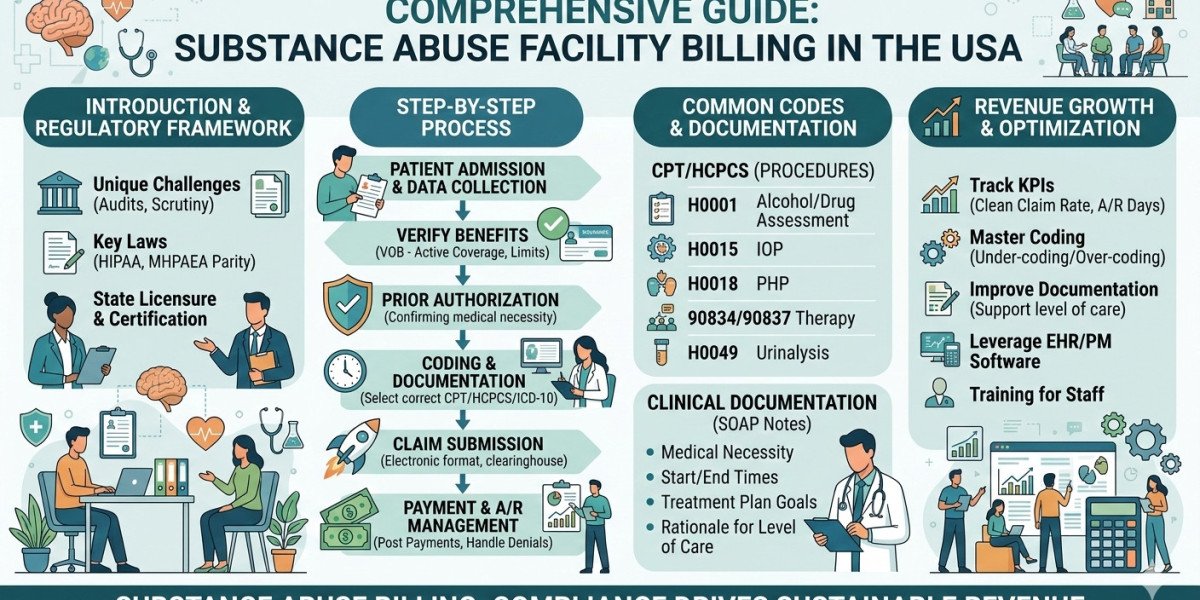

Medical Billing for Substance Abuse in USA: Complete Guide to Compliance and Revenue Growth
Substance abuse treatment centers across the United States face a unique combination of clinical, regulatory, and financial challenges. From prior authorizations and strict documentation requirements to payer audits and evolving CPT guidelines, medical billing for substance abuse is far more complex than standard outpatient billing.
When reimbursement delays affect cash flow, it directly impacts patient care, staffing stability, and long-term sustainability. This guide explains how medical billing for substance abuse works, why it is different from general billing, and how providers can optimize revenue while remaining fully compliant.
Introduction
Substance abuse treatment billing requires:
Accurate coding aligned with federal and state regulations
Careful documentation for inpatient, outpatient, and intensive programs
Strict adherence to payer-specific guidelines
Proper handling of Medicaid, Medicare, and commercial claims
Continuous denial management and compliance monitoring
Unlike routine medical billing, this specialty intersects heavily with behavioral health regulations and parity laws. Providers must understand both the clinical and financial aspects to ensure stable reimbursement.
Understanding Medical Billing for Substance Abuse
Medical billing for substance abuse covers services related to the diagnosis and treatment of addiction and substance use disorders (SUD). These services may include:
Detoxification programs
Residential treatment
Partial hospitalization programs (PHP)
Intensive outpatient programs (IOP)
Individual and group therapy
Medication-assisted treatment (MAT)
Each level of care has different billing codes, documentation standards, and authorization requirements.
Because addiction treatment often overlaps with behavioral health, many facilities also require medical billing for mental health integration within their revenue cycle structure. Accurate coordination between primary diagnosis, co-occurring disorders, and treatment plans is critical for claim approval.
Why Substance Abuse Billing Is More Complex
Substance abuse billing carries higher compliance risk compared to general outpatient billing.
Key complexity factors include:
Medical Necessity Documentation
Payers demand detailed clinical notes to justify each level of care. Missing treatment plans or progress notes can lead to immediate denials.Prior Authorizations
Many insurers require authorization before admission and for continued stay reviews.Parity Regulations
The Mental Health Parity and Addiction Equity Act ensures coverage equality, but payers still impose administrative hurdles that require active monitoring.State-Specific Medicaid Rules
Each state applies unique reimbursement guidelines for addiction services.
Because of this complexity, many facilities turn to a mental health billing company or mental health billing specialist companies that understand regulatory nuances.
Core Services Included in Substance Abuse Billing
Professional medical billing for substance abuse typically includes:
Insurance eligibility verification
Authorization tracking
Accurate CPT, HCPCS, and ICD-10 coding
Claim submission and follow-up
Appeals management
Patient billing and collections
Compliance auditing
Facilities that also provide psychiatric support often require billing for mental health services alongside addiction treatment billing. Coordinating both streams prevents fragmented claims and revenue leakage.
Integration with Mental Health Billing
Substance abuse treatment frequently involves co-occurring mental health conditions such as depression, anxiety, PTSD, or bipolar disorder. In such cases, medical billing for mental health services becomes part of the overall process.
This is where behavioral and mental health billing services play a critical role. Accurate coding must reflect:
Primary substance use diagnosis
Secondary mental health conditions
Therapy modalities
Medication management
Improper linking of diagnoses can cause partial payments or denials.
Some treatment centers choose outsourcing mental health billing and coding to maintain compliance across both addiction and psychiatric services.
Medicare and Medicaid Considerations
Billing Medicare for mental health services and substance abuse treatment requires strict adherence to coverage limitations.
Medicare typically covers:
Outpatient therapy
Medication management
Certain inpatient hospital services
However, coverage limitations may apply to residential or long-term treatment programs. Medicaid rules vary by state but often provide broader SUD coverage.
Accurate documentation and payer knowledge are essential when billing Medicare for mental health services within substance abuse programs.
Common Billing Challenges for Substance Abuse Centers
Even experienced providers encounter revenue obstacles.
Frequent issues include:
Incorrect level of care billing
Missed concurrent review deadlines
Incomplete therapy documentation
Coding errors in group therapy sessions
Failure to update credentialing records
Without strong denial management processes, rejected claims accumulate quickly.
This is why many organizations evaluate billing companies for mental health that also specialize in addiction services. Selecting the best mental health billing company requires reviewing experience in substance use disorder claims specifically, not just general psychiatry.
In-House Billing vs. Outsourcing
Treatment centers must decide whether to maintain internal billing teams or partner with a mental health billing services company.
In-house advantages:
Direct oversight
Immediate communication
Internal control
Outsourcing advantages:
Access to experienced coders
Reduced staffing costs
Improved compliance monitoring
Scalable support during census fluctuations
Outsourced billing for mental health often improves collections when the vendor understands payer-specific SUD policies.
However, not every cheap outsource mental health billing company delivers quality compliance oversight. Providers should prioritize expertise over low pricing.
What to Look for in a Billing Partner
When evaluating a top mental health billing company for substance abuse services, providers should assess:
Experience with detox, PHP, and IOP billing
Knowledge of state Medicaid rules
Dedicated denial management team
Transparent reporting metrics
Strong credentialing support
A reliable partner offering mental health billing and credentialing services ensures providers remain enrolled with payers and avoid claim rejections due to expired credentials.
The best outsource mental health billing and coding services maintain continuous education on evolving CPT and regulatory changes.
Coding and Documentation Best Practices
Successful coding and billing for mental health services within substance abuse programs requires:
Clear intake assessments
Detailed progress notes
Treatment plan updates
Accurate time documentation
Proper group therapy coding
For providers handling billing for mental health therapists within addiction centers, session duration and therapeutic modality must align precisely with billed codes.
Routine internal audits reduce risk exposure and protect against payer investigations.
Revenue Cycle Optimization Strategies
To strengthen financial performance in medical billing for substance abuse, facilities should:
Conduct monthly denial trend analysis
Monitor average reimbursement per level of care
Implement concurrent authorization tracking
Perform quarterly compliance audits
Review payer contracts annually
Mental health billing solutions that integrate analytics dashboards allow leadership to monitor revenue cycle health in real time.
Strong coordination between front-desk verification teams and billing departments minimizes preventable denials in billing mental health claims.
Role of Specialized Billing Services
As addiction treatment continues expanding nationwide, specialized billing services for mental health clinics are becoming essential.
A professional mental health medical billing structure ensures:
Clean claim submission
Faster reimbursement cycles
Reduced administrative burden
Lower audit risk
Increased collection rates
Facilities combining medical billing for mental health and substance abuse treatment benefit from unified revenue cycle management rather than fragmented billing systems.
Technology and Compliance Trends in USA
Recent developments influencing medical billing for substance abuse in the USA include:
Increased telehealth coverage
Electronic health record integration
Stricter documentation audits
Value-based reimbursement models
Providers delivering billing for mental health providers through telehealth must ensure correct modifiers and location codes are applied.
Technology-driven mental health billing services now integrate eligibility verification, coding validation, and automated claim tracking to improve efficiency.
Choosing a Strategic Revenue Cycle Partner
For addiction treatment centers seeking long-term stability, selecting a strategic partner is crucial.
247 medical billing services supports healthcare providers with comprehensive medical billing services, medical coding services, medical billing and coding services, revenue cycle management, and credentialing services tailored to specialty practices. For substance abuse and behavioral providers, having a partner experienced in both addiction and psychiatric reimbursement ensures stronger compliance and improved financial outcomes.
A reliable mental health billing company understands that revenue integrity directly impacts patient care access.
Conclusion
Medical billing for substance abuse in the USA requires far more than basic claim submission. It demands regulatory expertise, payer knowledge, strong documentation standards, and proactive denial management. Facilities that invest in specialized billing processes protect both revenue and compliance.
Whether managed internally or through outsourcing mental health billing, success depends on accuracy, transparency, and continuous oversight. When billing is optimized, providers can focus fully on delivering life-changing treatment to individuals battling addiction.
Frequently Asked Questions
What makes medical billing for substance abuse different from general medical billing?
Substance abuse billing requires strict documentation for medical necessity, authorization tracking, and compliance with behavioral health regulations, making it more complex than routine outpatient billing.
Does Medicare cover substance abuse treatment?
Medicare covers certain outpatient and inpatient addiction treatment services, but coverage limitations vary depending on the level of care and facility type.
Should substance abuse centers outsource billing?
Outsourcing can improve compliance and collections when partnering with experienced mental health billing specialist companies familiar with addiction treatment claims.
How can denial rates be reduced in substance abuse billing?
Regular documentation audits, accurate coding, timely authorizations, and continuous claim follow-up significantly reduce denial rates.
Is credentialing important for addiction treatment billing?
Yes. Active payer enrollment and updated provider credentials are essential for successful claim reimbursement and must be monitored continuously.