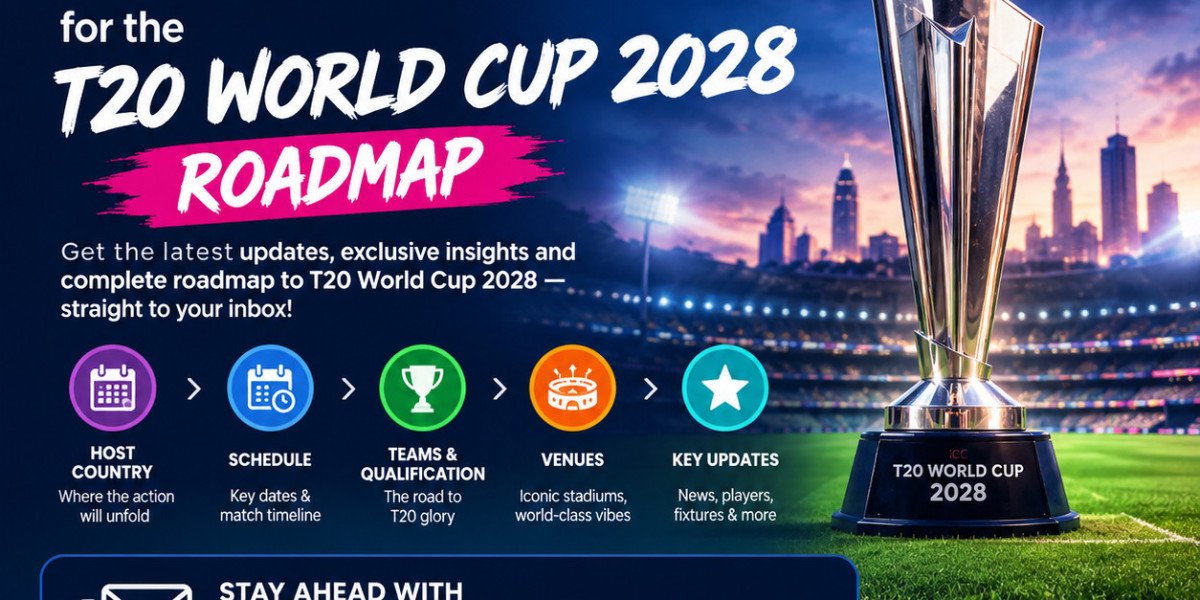

The next T20 World Cup is two years away. That is exactly why a roadmap newsletter is useful — and exactly why most roadmap newsletters fail.
They fail because they try to predict a squad in 2026 for a tournament in 2028, or because they send the same "countdown" email every week with nothing new in it.
A good roadmap newsletter does the opposite. It sends you a marker only when something on the road actually changes: a series result, a retention decision, an auction pick, a qualification result, or a format announcement. And it keeps the same three things in every edition, so you can follow the road without having to remember it all yourself.
Here is what that newsletter should look like, from where we are now in October 2026 to Australia and New Zealand in October-November 2028.
Where the road starts: India as defending champions
India are not starting the road to 2028 as challengers. They are starting as defending champions, twice over.
India won the T20 World Cup final on 8 March 2026 in Ahmedabad, beating New Zealand by 96 runs — India 255 for 5, New Zealand 159 all out — with Sanju Samson 89 off 46 as Player of the Tournament with 321 runs, Abhishek Sharma 52 off 21, Ishan Kishan 54 off 25, Jasprit Bumrah 4 for 15 as Player of the Final, and Axar Patel 3 for 27. Bumrah and Varun Chakaravarthy were joint top wicket-takers with 14 each.
That win made India the first team to win three T20 World Cups, the first to defend the title, and the first host to win at home, under captain Suryakumar Yadav and head coach Gautam Gambhir.
A roadmap newsletter should start there, because it explains the pressure of the next cycle. India are not trying to win a first title in 2028. They are trying to defend a title in conditions — Australia and New Zealand — that will be very different from Ahmedabad in March.
The 2028 format, in plain language
Before you follow players, follow the format. It has changed, and it changes what kind of squad India will need.
The 2028 Men's T20 World Cup, co-hosted by Australia and New Zealand — the first time New Zealand has hosted it — is scheduled for 20 teams and 55 matches in total.
The structure, as confirmed in ICC reporting, is:
- First stage: 20 teams in five groups of four
- Super 10 stage: Top two from each group advance to two groups of five
- Semi-finals: Group winners in the Super 10 go straight to the semi-finals
- Eliminators: Second-placed vs third-placed teams in the Super 10 play Eliminators for the other two semi-final places
Twelve teams are already qualified. The remaining eight places will come through qualification tournaments, which is why a roadmap newsletter needs a qualification tracker, not just an India tracker.
What that format means for India, in practical terms, is: you need a squad that can win a group, not just survive it, because topping a Super 10 group avoids an Eliminator. And you need depth for Australian bounce and New Zealand swing, not just for subcontinental spin.
A newsletter that only lists "players to watch" without explaining that format will miss why certain players matter more in 2028 than they did in 2026.
The roadmap markers: what should trigger an edition
A roadmap newsletter should not be weekly for the sake of being weekly. It should be triggered by markers. Here are the markers from now to 2028, in order:
Marker 1: New Zealand tour, October to December 2026 — happening now
- T20Is: Auckland on 30 October 2026, Hamilton on 1 November 2026, with India already leading 3-0 after Wellington, when India chased 199 in 13.2 overs after Abhishek Sharma's 113 off 38 balls
- ODIs: 4 to 15 November 2026, in Auckland, Wellington, Hamilton and Mount Maunganui
- Tests: 19 November to 1 December 2026, in Wellington and Christchurch
For the 2028 road, the T20I leg matters most. It is testing the next opening combination, the death-bowling group, and whether Arshdeep Singh — on 149 T20I wickets after 1 for 33 in Wellington, one away from becoming the first Indian to 150 — can lead an attack in New Zealand conditions.
Marker 2: IPL 2027 build-up, November to December 2026
- Retention deadline: 15 November 2026
- Mini-auction: reported for 16 December 2026 in Goa, with a briefing on 15 December, provisional until the BCCI issues an official email to franchises
A newsletter edition after retention and after auction should answer one question each time: which 2028 contenders kept their core, and which ones changed it?
Marker 3: IPL 2027 season, reported March to May 2027
IPL 2027 is reported as likely 14 March to 30 May 2027, but that window is not yet officially confirmed. This is the season where 2028 form will actually be built — not in theory, but in 14 league matches per team, under pressure, against international bowling.
Players to watch in that season, based on the current road, include Abhishek Sharma, Vaibhav Sooryavanshi, Tilak Varma, Nitish Kumar Reddy, Arshdeep Singh, and Sanju Samson for opener and No. 3 flexibility. Bhuvneshwar Kumar, recalled at 36 for the New Zealand tour, remains a question mark for 2028 — he would be 38 at the tournament — and should be presented as a question, not as a promise.
Marker 4: Qualification and fixture announcements, 2027 to 2028
As the remaining eight qualification places are decided, and as the final fixture list for October-November 2028 is published, a newsletter should update its qualification tracker and its venue list, and correct any earlier provisional dates. Do not book travel around a single date until that final fixture list is out.
Marker 5: Squad and conditions previews, 2028
Closer to the tournament, editions should shift from "who is in form" to "who fits Australia and New Zealand" — pace, bounce, swing, and the specific grounds in each host country. That is a different question from "who scored most runs in the IPL", and a good newsletter should say so.
What each newsletter edition should contain
If you subscribe to a roadmap newsletter, check that each edition has these five sections, in this order. If it does not, it is probably just a news roundup with a 2028 title on it.
1. One roadmap marker, in one line
What changed since the last edition? For example: "India sealed the T20I series 3-0 in Wellington" or "IPL 2027 retention list is out". One line, with a date.
2. Qualification tracker, updated
How many of the 20 places are filled? Which teams are already qualified, and which qualification tournaments are next? A tracker that never changes is not a tracker.
3. Player watch, with a reason
Not "five players to watch" with no reason, but "Abhishek Sharma — opening tempo in New Zealand" or "Arshdeep Singh — one wicket from 150, and death-bowling in New Zealand conditions". One reason per player, tied to 2028 conditions.
4. Format reminder, when it matters
When a new stage is announced, explain it again in plain language. Most fans will not remember the Super 10 and Eliminator structure from 2026 by the time 2028 arrives. Remind them when it matters, not every week.
5. What not to overreact to
One short section that says what not to take from the latest result. A single IPL fifty does not make a World Cup squad. A single poor series does not end a career. A roadmap newsletter that only hypes will mislead you by 2028.
This middle section is where fans usually check the 2028 roadmap together, with fixtures, qualification and player form in one place, alongside official ICC announcements. A platform like Cricbet99 is sometimes used for that kind of following, alongside official sources. That platform is a gaming and betting-related service, so any related features are for adults only, where legally permitted, and following a World Cup roadmap does not require using any betting feature.
How to subscribe safely, and how to leave
If you choose to subscribe to a roadmap newsletter, check these things first, on the subscription page itself:
Choose cricket-only updates, if that option exists. Pick scores, fixtures, squad and qualification news, and leave off separate options for odds movements or promotions, if they are listed separately. A roadmap newsletter should be about cricket, not about offers.
Check frequency. A roadmap newsletter should be marker-based — after a series, after retention, after auction, after qualification — not daily with no news. If the form does not say how often it will send, treat that as a warning sign.
Check unsubscribe before you subscribe. A trustworthy newsletter shows the unsubscribe link in the first edition, usually at the bottom, and honours it without asking you to log in. If you cannot find one, do not subscribe.
Do not share account details to get a newsletter. You should not need to share a password, an account login, or payment details to receive a free roadmap update. If a form asks for that, stop and use official ICC and BCCI announcements instead.
I cannot turn a subscription on inside an account from here, and I will not ask for login details to do it. The steps above are ones you can do yourself, using only the news part of a service.
Frequently Asked Questions
When is the T20 World Cup 2028?
In Australia and New Zealand, in October-November 2028. Updated listings put it at 12 October to 12 November 2028, while earlier listings put it at 21 October to 19 November 2028. Use October-November 2028 pending the final ICC fixture list, and do not book travel around a single date yet.
How many teams play in 2028, and what is the format?
20 teams, 55 matches. Five groups of four in the first stage, top two from each group to a Super 10 stage in two groups of five, group winners straight to the semi-finals, and second-vs-third Eliminators for the other semi-final places.
How many teams are already qualified?
Twelve teams are already qualified, with eight places to come through qualification tournaments. A roadmap newsletter should track those eight places as they are decided.
Who are India defending against in 2028?
India are defending champions, after winning in Ahmedabad in March 2026 by 96 runs against New Zealand. They are the first team to win three T20 World Cups and the first to defend the title.
What should I watch first on the road to 2028?
The New Zealand tour now — Auckland on 30 October and Hamilton on 1 November for T20Is, then ODIs and Tests — followed by IPL 2027 retention on 15 November 2026 and the mini-auction reported for 16 December 2026 in Goa.
Does subscribing require an account login?
A free roadmap newsletter should not require you to share a password or account login. If a form asks for that, stop and use official ICC announcements instead.
Final thoughts
A T20 World Cup roadmap is not a countdown clock. It is a series of markers, and each marker tells you something different about the team that will actually go to Australia and New Zealand in 2028.
Wellington told us about opening tempo and death bowling in New Zealand conditions. Retention and auction in November and December will tell us about squad cores. IPL 2027 will tell us about form under pressure. Qualification will tell us who India will actually face in the group stage.
A newsletter that follows those markers, in that order, with a qualification tracker and a clear "what not to overreact to" section, will be worth opening in 2028. A newsletter that just counts down the days will not.
If you subscribe, subscribe for the markers, not for the countdown — and unsubscribe if it stops giving you markers and starts giving you noise.
Note for readers: Cricbet99 is a gaming and betting-related platform. Any betting-related features are for adults only, where legally permitted, and should be used responsibly. Check the rules that apply in your location before using such services.







