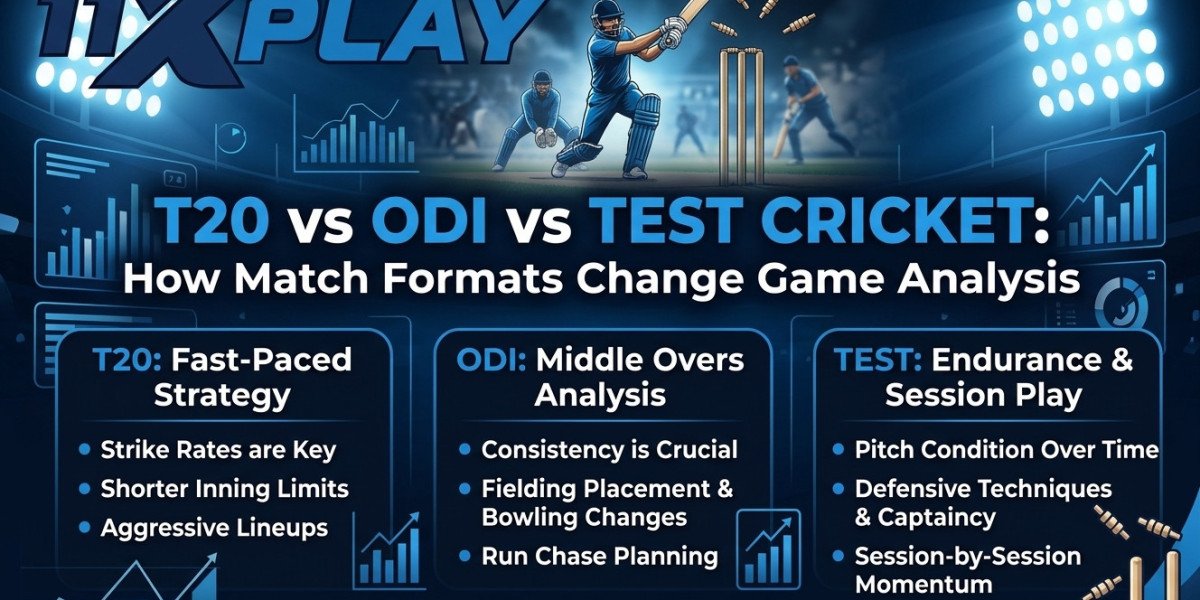

Cricket offers three major international formats, and each demands a different approach to match analysis. On 11xPlay, understanding the differences between T20, One Day International (ODI), and Test cricket can help readers interpret match conditions, team strategies, and performance statistics more clearly. Although all three formats follow the same basic rules, their pace, duration, and tactical demands vary considerably.
Understanding the Three Cricket Formats
Before comparing team performances, it helps to understand how each format works. The number of overs, available time, and importance of individual sessions can influence how teams approach a match.
T20 cricket: Each team faces a maximum of 20 overs. The shorter format encourages aggressive batting, quick scoring, and frequent changes in momentum.
ODI cricket: Each team receives a maximum of 50 overs. This format balances scoring speed with innings management and gives teams more time to recover from setbacks.
Test cricket: Matches can last up to five days, with each team usually having two innings. Patience, consistency, bowling endurance, and changing pitch conditions play major roles.
These differences explain why the same team or player may perform differently across formats.
How T20 Cricket Changes Match Analysis
T20 cricket moves quickly, so analysts often focus on immediate performance indicators. A strong start can create pressure on the opposition, while a few economical overs can change the direction of an innings.
Key factors include powerplay scoring, boundary frequency, strike rates, death-over performance, and the effectiveness of specialist bowlers. Team combinations also matter because all-rounders can contribute with both bat and ball.
However, aggressive scoring does not guarantee success. Losing wickets too early can leave a team with limited options during the final overs. Therefore, analysts should consider both scoring speed and wicket preservation.
When reviewing T20 matches on 11xPlay India, readers can compare recent team performances, player roles, and venue conditions rather than relying on a single statistic.
Why ODI Analysis Requires a Balanced Approach
ODI cricket provides more time to build an innings than T20 cricket. As a result, teams must balance steady accumulation with calculated aggression.
The powerplay, middle overs, and final overs each present different challenges. Openers may aim to establish a solid foundation, middle-order batters often manage the scoring rate, and finishers try to maximise runs near the end.
Important ODI analysis factors include:
Powerplay performance and early wickets.
Run rate and partnerships during the middle overs.
Batting depth and finishing ability.
Bowling economy, variations, and death-over control.
Pitch behaviour and weather conditions.
For example, a team that scores steadily without losing wickets may be well positioned to accelerate later. Conversely, repeated dismissals can force batters to prioritise rebuilding over attacking.
Unlike T20 cricket, ODI analysis requires greater attention to how a team manages its resources throughout a longer innings.
What Makes Test Cricket Different?
Test cricket rewards patience, adaptability, and sustained performance. Instead of focusing only on immediate scoring rates, analysts must consider how a match develops over several sessions and potentially five days.
Batting technique becomes especially important when bowlers exploit movement, uneven bounce, or deteriorating pitch conditions. Meanwhile, bowlers need discipline and stamina to maintain pressure across long spells.
Several factors deserve attention:
Pitch deterioration: A surface may become harder to bat on as the match progresses.
Bowling workload: Fast bowlers need effective rotation and recovery.
Partnerships: Long partnerships can change the balance of a match.
Session performance: A strong morning or afternoon session can create an advantage.
Match situation: Declarations, follow-on decisions, and remaining time influence tactics.
Test cricket also demands patience when conditions favour bowlers. A low-scoring session does not necessarily indicate poor batting; it may reflect difficult conditions and disciplined bowling.
T20 vs ODI vs Test: Key Differences
| Analysis factor | T20 | ODI | Test |
|---|---|---|---|
| Maximum overs per innings | 20 | 50 | Unlimited |
| Main batting focus | Fast scoring | Balanced scoring | Sustained survival and scoring |
| Match duration | Usually a few hours | Usually a full day | Up to five days |
| Important statistics | Strike rate, boundaries | Run rate, partnerships | Batting averages, bowling spells |
| Tactical priority | Quick momentum shifts | Resource management | Long-term adaptability |
These comparisons provide a useful starting point, but conditions and match situations can change the importance of each factor.
How Pitch and Weather Affect All Three Formats
Pitch conditions and weather influence every format, although their effects may differ. A dry surface can help spinners, while cloud cover and moisture may assist seam bowlers. However, these effects depend on the venue and actual playing conditions.
In T20 cricket, even a short period of difficult batting can affect the final score. In ODIs, teams have more overs to adjust their approach. In Test cricket, conditions can evolve over several days, making early observations especially valuable.
Rain interruptions also affect planning. Limited overs can change scoring expectations in shorter formats, while lost playing time can reduce the opportunities to force a result in Test matches.
Readers exploring the 11xPlay website should consider confirmed team news, ground conditions, and reliable match statistics together instead of treating one factor as decisive.
How to Compare Teams Across Formats
A useful analysis begins by comparing like with like. A team's recent T20 results may reveal little about its ability to succeed in a five-day Test because the formats demand different skills.
Follow these steps:
Review recent results in the same format.
Compare performances against teams of similar strength.
Check player availability, roles, and recent form.
Examine venue records and current conditions.
Consider how each team handles pressure and changing match situations.
If you plan to use platform features, understand the available information before proceeding. Read the app installation and safety guidance before downloading anything, and use the appropriate 11xplay register and 11xplay login pages only after verifying the website's authenticity. Keep your 11xplay ID secure and never share confidential account details.
Conclusion
T20, ODI, and Test cricket require different analytical approaches. T20 emphasises quick decisions and scoring momentum, ODI balances aggression with innings management, and Test cricket rewards patience and adaptability. By comparing format-specific statistics, team roles, pitch conditions, and match situations, readers can develop a clearer understanding of how cricket strategies change across the three formats. A careful approach on 11xPlay starts with reliable information rather than assumptions.