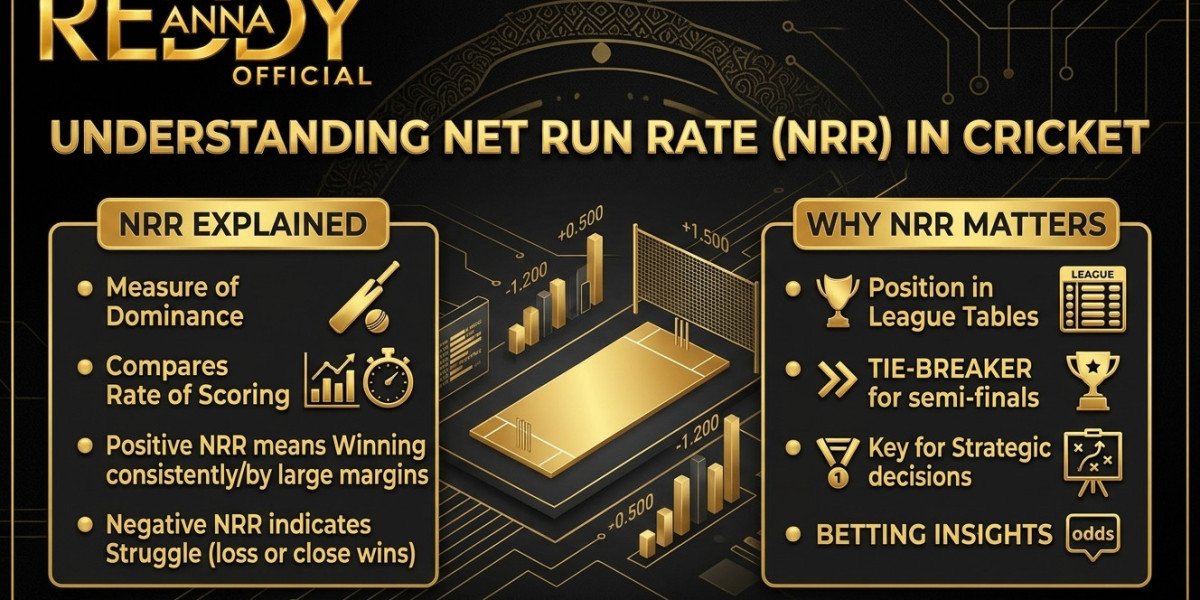

Net run rate (NRR) helps cricket fans understand how efficiently a team scores runs compared with how quickly it concedes them. On Reddy Anna, understanding this statistic can help readers follow tournament standings, compare team performances, and interpret qualification scenarios more clearly. Although wins remain crucial, net run rate can become a deciding factor when teams finish level on points.
What Is Net Run Rate in Cricket?
Net run rate measures the difference between a team's average runs scored per over and its average runs conceded per over. Cricket tournaments commonly use this calculation to separate teams with equal points.
A positive NRR generally indicates that a team scores faster than its opponents do against it. Conversely, a negative figure suggests that opponents score at a higher rate.
However, NRR does not tell the whole story. A team might win several close matches but have a lower NRR than a side that records a few dominant victories.
How Is Net Run Rate Calculated?
The basic formula is straightforward:
Net Run Rate = Average runs scored per over − Average runs conceded per over
For example, suppose a team scores 160 runs in 20 overs. Its opponent then scores 140 runs in 20 overs.
Team's scoring rate: 160 ÷ 20 = 8.00
Opponent's scoring rate: 140 ÷ 20 = 7.00
Net run rate: 8.00 − 7.00 = +1.00
The team finishes with an NRR of +1.00 for that match.
In tournaments, however, officials calculate NRR using the combined figures from all applicable matches, rather than simply averaging each match's NRR.
Why Does Net Run Rate Matter in Tournament Standings?
Teams earn points through match results, but those points do not always separate every team. When two or more sides finish level on points, tournament rules may use NRR as a tie-breaker.
For example, two teams might each finish with eight points. If Team A has an NRR of +0.85 and Team B has +0.30, Team A generally ranks higher when NRR is the applicable tie-breaker.
This makes NRR particularly important during the final stages of a tournament. A convincing win can improve a team's position, while a heavy defeat can reduce its chances of qualifying.
Still, the exact qualification process depends on the competition's official rules and any other applicable tie-breakers.
What Can Net Run Rate Tell You About Team Performance?
NRR offers useful clues about how a team performs across a tournament.
1. Scoring efficiency: A strong scoring rate can improve NRR, particularly when batters maintain momentum throughout their innings.
2. Bowling effectiveness: Restricting opponents to fewer runs helps a team improve its NRR. Therefore, economical bowling and timely wickets can make a difference.
3. Consistency across matches: One dominant win may improve NRR, but repeated heavy defeats can offset that advantage. Overall performance matters more than a single result.
4. Tournament position: When teams share the same points, NRR can help explain why one side sits above another in the standings.
Nevertheless, NRR should not replace a broader assessment of performance. Team combinations, opposition strength, pitch conditions, and match circumstances also influence results.
How Do All-Out Innings Affect Net Run Rate?
One important detail concerns teams that lose all their wickets before completing their allotted overs.
For NRR calculations, a team's innings is generally treated as having used its full quota of overs when it is dismissed before that quota expires. This rule prevents a short, unsuccessful innings from producing an artificially high scoring rate.
For example, if a team gets bowled out for 100 in 15 overs during a 20-over match, the calculation generally uses 20 overs for that innings. Competition-specific regulations should always take precedence.
This detail matters because a team's NRR can change considerably after a collapse, even when the innings ends well before the scheduled overs.
Can a Team Qualify With a Negative Net Run Rate?
Yes. A negative NRR does not automatically eliminate a team from a tournament.
If a team earns enough points to qualify, it may progress despite having a negative figure. However, when several teams finish level on points, a lower NRR can place that team at a disadvantage.
For this reason, teams often consider both winning matches and managing the margin of victory or defeat. Even so, chasing an improved NRR cannot guarantee qualification because other teams' results and the tournament's rules also matter.
Readers using the Reddy Anna app to follow cricket updates should distinguish between a team's current standing and its final qualification status.
Common Misunderstandings About Net Run Rate
A few common errors can make NRR confusing:
Treating NRR as a win percentage: NRR measures scoring and conceding rates, not the proportion of matches won.
Assuming one big win guarantees qualification: Other results can still change the standings.
Ignoring overs and all-out rules: The calculation follows specific conventions, so the number of balls faced may not always determine the overs used.
Confusing match NRR with tournament NRR: Tournament NRR uses cumulative figures from applicable matches.
For accurate interpretation, readers should consult official scorecards and the competition's published standings.
Conclusion
Net run rate provides a useful way to compare teams beyond points alone. It shows how efficiently a side scores and restricts opponents, while also helping explain qualification scenarios when teams finish level on points. By understanding its formula, all-out rules, and tournament application, cricket followers can interpret standings with greater confidence. Whether checking a scorecard or reviewing updates through the Reddy Anna official website, always consider NRR alongside points, match results, and the competition's rules.