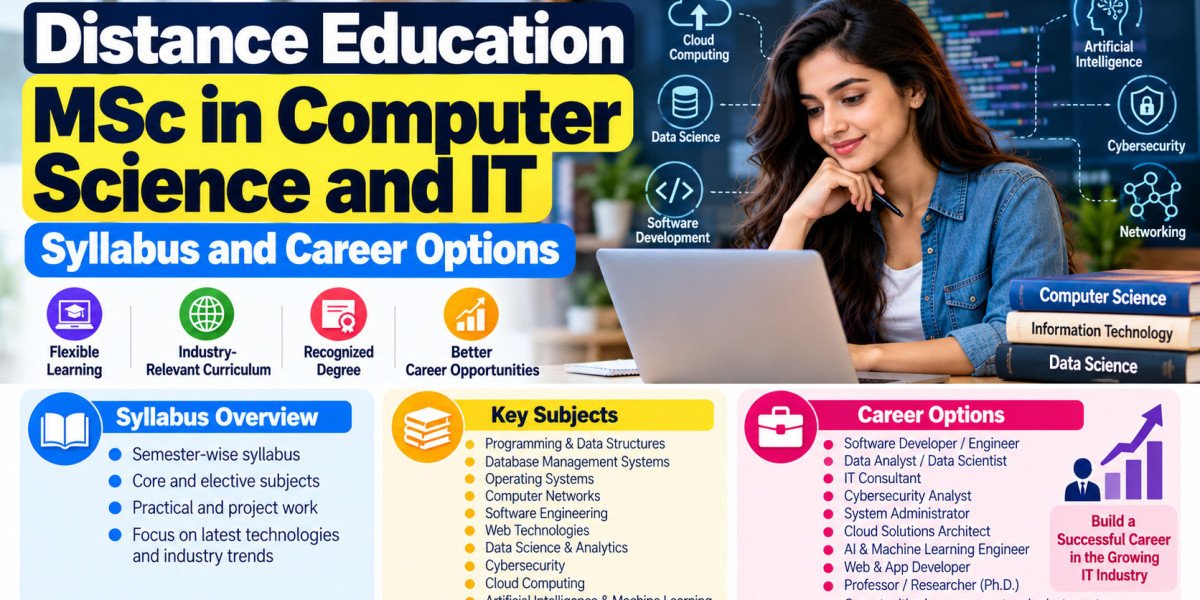

Technology moves fast, and many working professionals reach a point where experience alone is not enough. A postgraduate degree can unlock promotions, better roles, and teaching opportunities, but leaving a job for two years is rarely practical. That is why a Distance Education MSc in Computer Science and IT has become one of the most popular choices among working graduates.
This guide explains what you will study, how the syllabus is structured, who can apply, what the program costs, and which careers it can lead to. If you are comparing options for MSc Distance Education, this article will help you decide whether Computer Science or IT is the right specialization for you.
What Is a Distance Education MSc in Computer Science and IT?
An M.Sc in Computer Science or Information Technology through distance mode is a two-year postgraduate program that covers programming, systems, networks, databases, and software development. You learn through digital study material, recorded or live lectures, assignments, and term-end exams, instead of attending daily classes.
Computer Science focuses more on theory, algorithms, and computing concepts. IT leans toward applications, systems management, networking, and business technology. Some universities combine both in a single program, while others offer separate degrees. Program names and approvals change each session, so confirm the current offering on the UGC-DEB website and the university’s admission page.
Why Choose M.Sc Distance Education in Computer Science and IT?
Fits working schedules. Most learners are already employed in IT or related fields, and distance mode lets them study evenings and weekends.
Practical learning. Much of computer science can be practiced on your own laptop, so lab limitations are smaller than in Physics or Chemistry.
Career growth. A postgraduate degree can support promotion, a move into management, or a shift to teaching.
Lower cost. Fees are usually lower than regular programs, and you save on relocation and living costs.
Immediate application. You can apply what you learn at work right away, which strengthens both your skills and your results.
Eligibility Criteria
Rules differ by university, but these are common requirements.
Bachelor’s degree. A B.Sc in Computer Science, IT, or Mathematics, or a degree such as BCA, B.Tech, or B.E. in a related field. Some universities accept graduates from any science stream and ask them to complete a bridge course.
Minimum marks. Often 45 to 50 percent in graduation, with relaxation for reserved categories. Some universities require only a pass.
Entrance exam. Usually not required, though a few private and online universities conduct an aptitude test or counselling.
Age limit. Typically none.
Work experience. Not required in most cases, but it helps in applied or professional programs.
Always confirm the exact rules in the official prospectus.
Course Duration
The standard duration is two years, divided into four semesters or two annual cycles. Distance learners are often allowed extra time, commonly up to four years, to complete the degree. Check your university’s rules on the maximum duration and on re-registration.
Typical Syllabus Structure
Most programs follow a pattern like this.
First year. Foundation and core papers in programming, data structures, databases, and operating systems.
Second year. Advanced papers, electives for specialization, and a final project or dissertation.
Syllabus content varies widely between universities, and some update it more often than others. Download the syllabus from each shortlisted university and compare how current it is.
Core Subjects You Will Study
Data structures and algorithms. Arrays, linked lists, trees, graphs, sorting, searching, and the analysis of algorithm efficiency. This is the backbone of programming and technical interviews.
Database management systems. Relational models, SQL, normalization, transactions, and database design. Some programs also cover NoSQL databases.
Operating systems. Process management, memory management, file systems, and concurrency.
Computer networks. Network models, protocols, routing, security basics, and internet technologies.
Software engineering. Requirements analysis, design methods, testing, project management, and agile practices.
Object-oriented programming. Concepts and practice using languages such as Java, C++, or Python.
Theory of computation and compiler design. Automata, formal languages, and how programming languages are translated into machine code. These topics appear more in Computer Science than in IT programs.
Web technologies. HTML, CSS, JavaScript, server-side programming, and web application development.
Elective and Specialization Options
Many universities allow electives in the second year. Common choices include:
- Artificial intelligence and machine learning
- Data mining and data warehousing
- Cloud computing
- Cybersecurity and cryptography
- Big data analytics
- Mobile application development
- Internet of Things
- Information retrieval and natural language processing
- Image processing
- Distributed systems
Choose electives based on the job market and your own interests. Fields such as cloud computing, cybersecurity, and data analytics currently see strong demand.
Practicals and Projects
Unlike lab-based sciences, computer science practicals can usually be done on your own computer. Programs may require:
- Programming assignments submitted online
- Practical exams, either online or at a study center
- A final project or dissertation, often involving a real software application or research topic
Check whether practical exams require you to visit a center, and whether the university charges separate practical fees. The final project is also a valuable chance to build something you can show employers.
Assignments and Examinations
Assignments. Submitted during each semester, often carrying 20 to 30 percent of final marks.
Term-end exams. Conducted at designated centers or through online proctoring. They usually include theory questions, problem solving, and sometimes code writing.
Passing marks. Many universities require around 40 to 50 percent per paper, though this varies.
Practice coding regularly rather than relying only on reading, since exams and interviews both test applied skills.
Fees for Distance Education MSc in Computer Science and IT
As a general estimate, public and open universities charge roughly 10,000 to 40,000 rupees per year, while private or deemed universities with online classes and career support may charge significantly more. Costs outside the main fee can include exams, projects, practicals, and re-registration. Calculate the full two-year cost before deciding, and confirm current fees on the official website, since they change each session.
Career Options After Distance Education MSc in Computer Science and IT
This degree supports a wide range of roles, especially when paired with practical skills and experience.
Software developer. Designing, building, and maintaining applications for web, mobile, or enterprise use.
Systems analyst. Analyzing business needs and designing technology solutions.
Database administrator. Managing and securing databases for organizations.
Network engineer or administrator. Setting up and maintaining network infrastructure.
Web developer. Building websites and web applications.
Data analyst or data engineer. Working with large datasets, especially if you choose analytics electives.
Cybersecurity analyst. Protecting systems and data, often with additional certifications.
IT project manager. Leading technology projects, a common path for experienced professionals.
Teaching and training. Computer science teaching at school level, and at college level with UGC NET or SET qualification.
Government IT roles. Many government departments recruit for technical posts. Read each notification to confirm that distance degrees are accepted.
Salaries depend on your skills, experience, employer, and location. In IT, demonstrated skills and projects often matter as much as the degree itself.
Boosting Your Profile With Certifications and Projects
A degree opens the door, but skills keep it open. Consider adding:
- Cloud certifications from major providers
- Cybersecurity certifications
- Data science or machine learning courses
- Programming practice on coding platforms
- Open-source contributions
- A portfolio of personal or work projects
- Preparation for GATE or UGC NET if you plan to teach or study further
Employers frequently look at portfolios and practical experience, so keep building while you study.
Is a Distance Degree Accepted in the IT Industry?
Private IT companies generally focus on skills, projects, and interview performance. A degree from a recognized university is usually enough to meet educational criteria, and many working professionals earn promotions by completing it. Government jobs and academic positions may have specific rules about distance degrees, so check each notification carefully. For PhD admission, individual departments decide whether to accept distance degrees.
How to Choose the Right University
- Confirm UGC-DEB approval for the exact program and session
- Check that the syllabus includes current topics such as cloud, AI, and security
- Look at how practicals and projects are conducted
- Compare total fees, including exams and practical charges
- Review the quality of the learning portal and live or recorded lectures
- Check exam center locations and whether online exams are offered
- Ask alumni about their experience and career outcomes
Tips to Succeed While Working Full-Time
Set a fixed schedule. Even one or two hours daily adds up over months.
Practice coding often. Short daily practice beats long, irregular sessions.
Apply concepts at work. Use databases, scripts, or tools from your course in real tasks where possible.
Build a project early. Start thinking about your final project in the first year.
Use previous papers. They reveal the exam pattern and common topics.
Stay connected. Join forums or study groups for doubts and motivation.
Plan for exam time. Take leave in advance if exams fall during busy work periods.
Common Mistakes to Avoid
- Choosing a program with an outdated syllabus
- Skipping approval checks and enrolling in an unrecognized program
- Ignoring practical and project requirements
- Relying only on theory without writing code
- Neglecting assignment deadlines
- Assuming the degree alone guarantees a job
Final Thoughts
A Distance Education MSc in Computer Science and IT is a practical option for working professionals who want to grow without pausing their careers. It offers flexibility, relevant skills, and a path to better roles, especially when combined with certifications and real projects.
Before applying, verify UGC-DEB recognition, compare syllabi, and confirm the complete fee structure. With consistent effort, your M.Sc Distance Education in Computer Science and IT can help you move toward the career you want.
https://www.inboxjournal.com/id/mcmglobaleducation
https://www.mcmglobaleducation.com/blog/is-pgdm-worth-it/
https://www.mcmacademy.in/graduation-degree-one-year-bangalore/
https://www.mcmacademy.in/b-ed-in-one-year/
https://www.mcmacademy.in/fast-track-courses/
https://www.mcmacademy.in/blog/top-10-llm-specializations-in-demand/
https://www.mcmacademy.in/blog/best-ece-colleges-in-india/
https://www.mcmacademy.in/bcom-distance-education/
https://www.mcmacademy.in/mcom-distance-education/