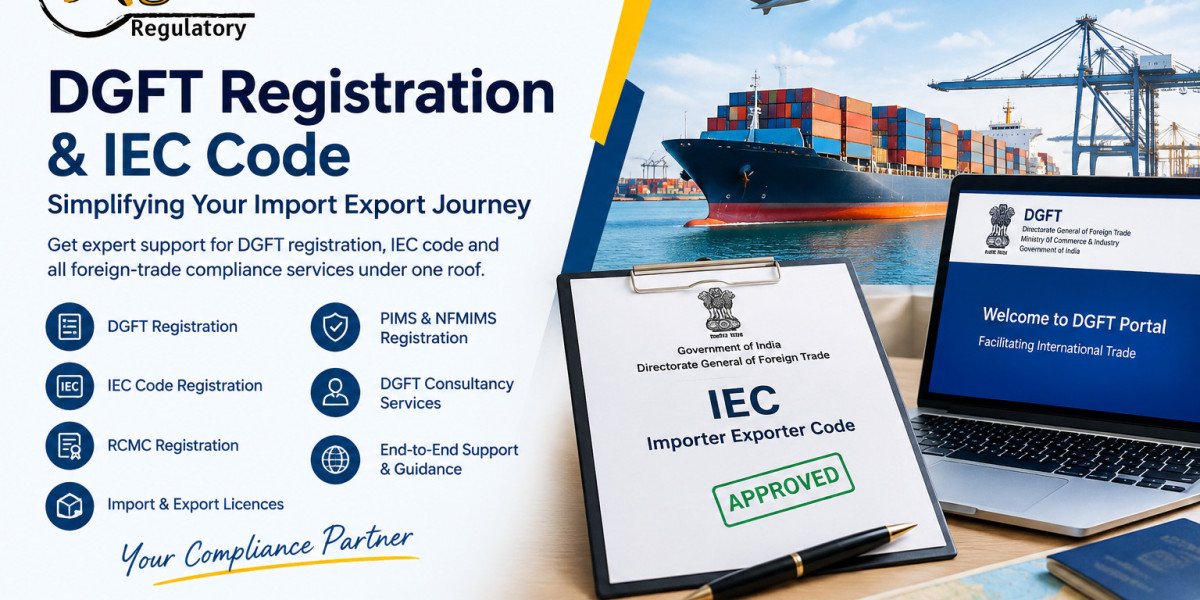

Starting an import-export business involves more than finding suppliers or customers in another country. Businesses also need to understand customs procedures, product-specific rules, and the registrations required before trading internationally. One of the first steps for many Indian businesses is obtaining an Importer Exporter Code (IEC) through the Directorate General of Foreign Trade (DGFT).
If you are researching DGFT registration, it is important to understand that IEC registration and an import licence are not the same thing. An IEC identifies an importer or exporter for foreign trade purposes, while certain products may require additional permissions under India's Foreign Trade Policy.
This guide explains how to apply for a DGFT certificate, what documents to prepare, how the online process works, and which compliance points businesses should check before submitting an application.
What is DGFT registration?
The Directorate General of Foreign Trade operates under the Ministry of Commerce and Industry, Government of India. It administers India's Foreign Trade Policy and manages several import-export authorisations and related online services.
For most businesses entering international trade, the key starting point is DGFT IEC registration. The IEC is a unique code generally required for importing goods into India or exporting goods from India, subject to applicable exemptions.
The IEC is linked to the applicant's business identity and PAN. It is not a general approval for every product. For example, an importer may have a valid IEC but still need a separate authorisation to import restricted goods.
Before applying, identify the activity you intend to carry out. This will help you determine whether you need only an IEC or another DGFT permission as well.
Who should apply for an IEC?
An IEC is generally relevant to:
Manufacturers purchasing machinery or raw materials from overseas suppliers.
Traders importing products for resale in India.
Exporters selling finished goods to international buyers.
Businesses entering cross-border e-commerce or other eligible export activities.
Companies expanding their existing domestic operations into international markets.
Certain categories of transactions or persons may be exempt under the applicable rules. Businesses should check the current Foreign Trade Policy rather than assuming that every cross-border transaction follows the same requirements.
Documents required for DGFT IEC registration
Preparing accurate information before opening the application can reduce avoidable errors. The exact information required depends on the applicant's legal structure and the current DGFT application form.
Common requirements include:
PAN details of the applicant or business.
Proof of the business address.
A valid bank account and supporting bank details or proof.
Active email address and mobile number.
Applicant or authorised signatory details.
Digital photograph or other supporting information where required by the portal.
Digital authentication or electronic signing credentials, depending on the available application method.
For a proprietorship, partnership, LLP or company, the supporting information may differ. The name and PAN details should be consistent with the relevant records. If the business has recently changed its address or legal name, check whether those details have been updated before applying.
Do not upload unclear documents or use another person's bank details without a valid legal basis.
How to apply for a new IEC code through DGFT
The application is handled online through the official DGFT portal.
Step 1: Create or access your DGFT account
Visit the official DGFT website and access the registration and login options. Use the applicant's correct email address and mobile number.
Step 2: Link the business details
Complete the profile and enter the relevant PAN, business and contact information. Check that the details match the supporting documents.
Step 3: Open the IEC application
Select the applicable IEC application service. Enter the requested information about the applicant, business address and bank account.
Step 4: Upload the required documents
Provide the supporting documents in the format requested by the portal. Check file readability, names, dates and consistency before proceeding.
Step 5: Review and authenticate
Read the declarations carefully. Complete the electronic signing or authentication step available for your application.
Step 6: Pay the government application fee
The DGFT IEC user manual lists an application fee of ₹500. Confirm the fee displayed on the official portal before paying, as online instructions and requirements can change.
Step 7: Submit and monitor the application
Save the acknowledgement and payment receipt. Check your DGFT account and registered email for the application status, any deficiency notice, or the digitally issued IEC.
What are the DGFT registration fees?
Applicants often search for DGFT registration fees before beginning the process. It helps to distinguish government charges from professional service charges.
The official IEC application guidance identifies a government fee of ₹500 for a new application. Modification charges and fees for other authorisations can differ. A restricted-item licence, for example, follows its own applicable fee rules.
If you engage a DGFT consultant, the professional fee will depend on the scope of work. It may cover document review, application preparation, filing assistance and follow-up. Ask for a clear breakdown so you understand which amounts are government fees and which are service charges.
What happens after receiving the IEC?
Receiving the IEC is an important milestone, but it does not remove all import-export responsibilities.
Businesses should also:
Keep their IEC profile and contact details accurate.
Complete the required annual IEC confirmation or update within the applicable period.
Check the ITC (HS) classification and current import-export policy for each product.
Review customs, tax, labelling and product-specific compliance requirements.
Obtain any additional authorisation needed for restricted goods.
IEC details should be reviewed even if the business has not conducted any imports or exports recently. Check the current DGFT instructions for the annual update requirement and the consequences of non-compliance.
Common mistakes to avoid
The most frequent problems include PAN or business-name mismatches, incorrect bank details, unclear uploads, an inactive email address and incomplete declarations.
Another common mistake is assuming that an IEC automatically permits the import of every product. Restricted goods may need a separate licence, while certain products may fall under other regulatory requirements.
A final issue is using unofficial websites without verifying whether they are authorised. Always begin with the official DGFT portal and keep copies of submitted forms and payment receipts.
When should you consult a DGFT professional?
A professional can be useful if your business has a complicated ownership structure, needs IEC corrections, receives a deficiency notice or plans to import goods that may require additional authorisation.
Agile Regulatory assists businesses with IEC-related documentation and regulatory application support. Before seeking assistance, identify the product, proposed transaction and type of approval you need. This makes it easier to establish the correct scope of work.
Frequently asked questions
1. What is a DGFT certificate?
The term is commonly used for the IEC certificate issued through DGFT. Other DGFT authorisations may be required for specific import or export activities.
2. Who issues the IEC code?
The IEC is issued through the Directorate General of Foreign Trade, under the Ministry of Commerce and Industry, Government of India.
3. How much is the IEC application fee?
The official DGFT IEC application guidance lists ₹500 for a new IEC application. Verify the amount on the portal before payment.
4. Can I apply for IEC registration online?
Yes. The application process is available through the official DGFT portal.
5. Is an IEC enough to import restricted goods?
No. A separate authorisation or permission may be required depending on the product's current import policy.
Conclusion
For an Indian business that is looking to start international trade, registering with the DGFT is a sensible first step. Check document requirements, submit the right information, and review product-specific restrictions to avoid common application issues. The first and foremost thing you will need to do is to find out if your activity requires an IEC or an additional licence before placing an import order.