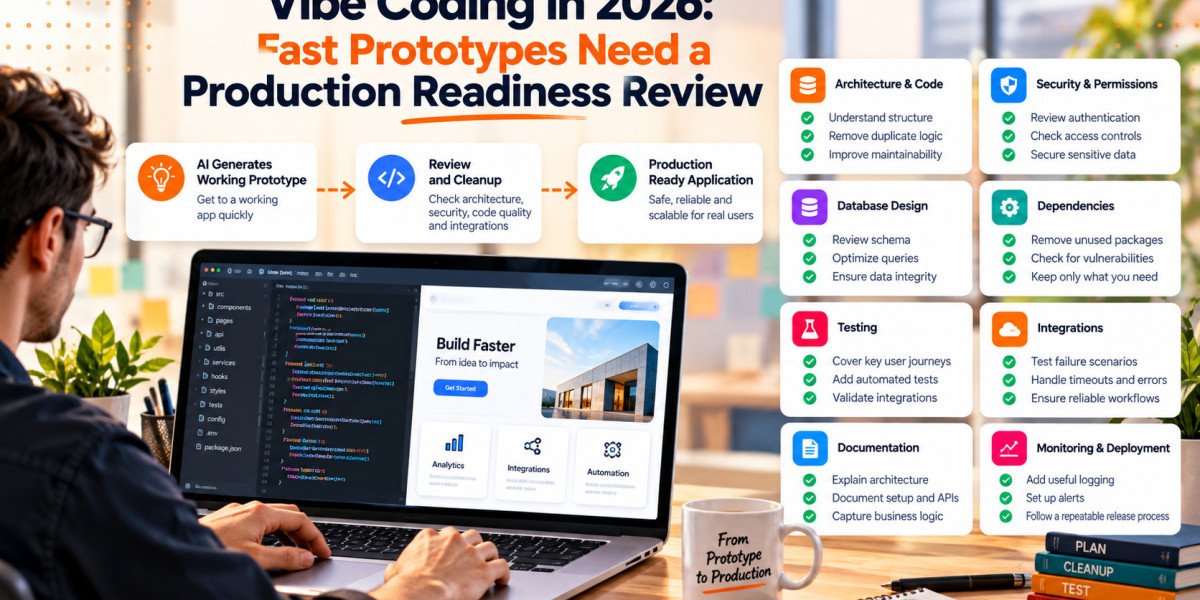

AI coding tools have changed how quickly software ideas can become working products.
A founder or product team can now describe a requirement, generate the interface, connect a database, add authentication, create APIs, and produce a usable prototype in a fraction of the time that traditional development once required.
That speed is useful. It also creates a new responsibility.
Before an AI built application handles real users, customer information, payments, or important business processes, it needs a structured Vibe Coding Cleanup review.
The goal is to make sure the application is understandable, secure, testable, maintainable, and ready for production use.
A Working Prototype Is Only the Starting Point
An application can appear complete while still carrying technical risk.
The interface may work.
Users may be able to register.
The database may store information correctly.
The main workflow may complete successfully.
Problems often appear later because generated code may contain:
- Duplicate business logic
- Weak permission checks
- Unused dependencies
- Large files with several responsibilities
- Inconsistent error handling
- Missing tests
- Poor documentation
- Exposed configuration values
- Database rules that were never reviewed
- Integrations without retry logic
These issues may not stop an early demonstration.
They become more important as the application grows.
Start With an Architecture Review
Cleanup should begin by understanding the current system.
A basic review should identify:
- Frontend structure
- Backend services
- Database design
- Authentication
- Authorization
- External APIs
- Storage
- Background processes
- Deployment setup
- Logging and monitoring
This gives the team a clear view of how the application works.
It also helps identify areas where several development sessions may have introduced overlapping logic.
Authentication Is Not the Same as Authorization
AI generated applications often implement login correctly.
That does not automatically mean permissions are safe.
Authentication confirms who the user is.
Authorization determines what that user can access or change.
A production review should check questions such as:
- Can one customer read another customer’s records?
- Can a standard user call an admin endpoint?
- Can protected fields be changed through an API request?
- Are role checks enforced on the backend?
- Are sensitive actions protected independently of the interface?
Hiding an admin button is not enough.
The server must enforce the permission.
Secrets Need Proper Management
Rapid development often encourages teams to place credentials directly into configuration files or source code.
Before production, review for:
- API keys
- Database passwords
- Service credentials
- Cloud tokens
- Webhook secrets
- Private keys
These values should be stored using environment configuration or an appropriate secret management system.
Repository history should also be reviewed when sensitive values were committed earlier.
Database Design Deserves a Cleanup Pass
Generated applications can create database structures quickly.
The schema still needs to make business sense.
Review:
- Table relationships
- Duplicate fields
- Naming
- Data types
- Required values
- Indexes
- Ownership rules
- Delete behavior
- Migration history
- Audit requirements
The objective is to make sure important business information has one clear meaning.
A field such as customer status should not have several competing versions created by different features.
Dependencies Can Grow Quietly
AI coding tools can install libraries whenever a requirement appears.
Over time, the application may include multiple packages solving similar problems.
A dependency review should look for:
- Unused libraries
- Outdated packages
- Vulnerable dependencies
- Duplicate functionality
- Packages added for temporary experiments
Every dependency increases maintenance work.
If a package no longer has a clear purpose, it should be reviewed.
Critical User Journeys Need Tests
Testing becomes especially important before refactoring AI generated code.
Start with business critical workflows.
Examples include:
- Sign up
- Login
- Password reset
- Payment
- Account permissions
- File upload
- Customer record updates
- Subscription changes
- External API integrations
Automated tests give engineers confidence that cleanup work has not broken important behavior.
They also make future AI assisted development safer.
Integration Failures Need Planned Behavior
Applications increasingly depend on external systems.
An AI built product may connect to:
- Payment gateways
- CRM
- ERP
- Authentication providers
- Analytics platforms
- AI APIs
- File storage
The happy path is only part of the design.
Teams should also test:
- Timeouts
- Invalid responses
- Expired credentials
- Rate limits
- Duplicate requests
- Temporary outages
- Partial failures
The application needs a clear response when another service stops working.
Logging Should Help Reconstruct Problems
Production software needs useful operational information.
When a customer reports a problem, the team should be able to determine:
- Which user triggered the action
- Which request failed
- Which service was involved
- Which record was affected
- What error occurred
- What happened immediately before the failure
Logging should provide useful context while protecting sensitive customer information.
Documentation Makes AI Built Software Maintainable
One of the risks of rapid AI development is that much of the project knowledge stays inside old prompts or chat sessions.
That knowledge needs to move into documentation.
Useful documentation should explain:
- System architecture
- Local setup
- Environment variables
- Database structure
- External services
- API responsibilities
- Permission rules
- Deployment process
- Important business logic
- Known limitations
This gives future developers enough context to work safely.
Refactoring Should Make the System Easier to Understand
Cleanup does not automatically mean rewriting the whole application.
A full rewrite can create new risk.
Start with areas that cause the most confusion or maintenance work.
Common candidates include:
- Duplicate functions
- Very large components
- Repeated API logic
- Dead code
- Unclear naming
- Mixed responsibilities
- Inconsistent validation
- Repeated database queries
Each cleanup change should make the system easier to explain.
AI Can Help With Cleanup
AI coding tools can also support the review process.
They can help identify duplicate logic, generate tests, explain unfamiliar code, find unused functions, review dependencies, draft documentation, and suggest refactoring options.
The team should still define the cleanup plan.
AI is most useful when engineers know what quality standard they are trying to reach.
Production Readiness Needs Clear Answers
Before launch, the team should be able to answer these questions confidently:
Architecture:
Can the team explain how the major parts of the application work together?
Security:
Are authentication, permissions, secrets, and customer data protected?
Database:
Is the schema understandable and controlled?
Testing:
Are important user journeys protected?
Integrations:
Are failure cases handled properly?
Observability:
Can the team understand what happened when something breaks?
Documentation:
Can another developer maintain the application?
Deployment:
Is there a repeatable release and rollback process?
If these answers are unclear, the application still needs engineering work before production.
AI Has Changed Where Engineering Time Goes
AI has reduced the effort required to create the first version of a product.
Engineering effort is increasingly moving toward validation, security, testing, architecture, documentation, and long term maintainability.
That is a useful shift.
Teams can test ideas faster and spend more effort strengthening the products that prove valuable.
Vibe coding can accelerate the prototype.
Cleanup is what helps turn that prototype into software a business can depend on.