
A strong resume should clearly show what you can do. While soft skills describe how you work, hard skills for resume content focuses on specific abilities that can be learned, measured, and demonstrated.
Choosing the right hard skills can help recruiters quickly understand your qualifications and determine whether your background matches the position.
What Are Hard Skills?
Hard skills are technical or job-specific abilities that are usually developed through education, training, certifications, or practical experience.
Examples include:
Data analysis
Microsoft Excel
Programming
SEO
Graphic design
Project management
Accounting
Database management
Digital marketing
Customer relationship management
The best skills to include depend on the position you are applying for.
Why Are Hard Skills Important on a Resume?
Employers often look for specific skills when reviewing applications. Including relevant hard skills makes it easier for recruiters to see whether your experience matches the requirements of the job.
Hard skills can also be important for Applicant Tracking Systems (ATS), which may scan resumes for keywords related to the job description.
However, adding a long list of unrelated skills is not an effective strategy. Relevance matters more than quantity.
Examples of Hard Skills for Resume
Different careers require different technical abilities. Here are a few examples:
Marketing
SEO
Google Analytics
Email marketing
Content management
Social media advertising
Technology
Python
JavaScript
SQL
Cloud computing
Version control
Finance
Financial analysis
Budgeting
Accounting software
Financial reporting
Microsoft Excel
Design
Adobe Photoshop
Adobe Illustrator
Figma
UI design
Video editing
Project Management
Project planning
Risk management
Budget management
Agile methodology
Project management software
How to Choose the Right Hard Skills
Start by reviewing the job description. Look for technical skills, software, tools, certifications, and other specific qualifications mentioned by the employer.
Then compare those requirements with your actual experience.
For example, if a job requires Excel, data analysis, and reporting, and you have experience using these skills, make sure they are clearly visible on your resume.
Avoid adding skills simply because they appear frequently in online lists. You should be able to confidently explain and demonstrate every skill you include.
Where Should You Add Hard Skills?
A dedicated skills section is the easiest place to list your technical abilities. However, don't rely on this section alone.
You can also demonstrate your hard skills through your professional experience.
Instead of simply writing:
SEO
You could show how you used it:
Optimized website content using SEO techniques and keyword research to improve organic visibility.
This gives the recruiter evidence that you have actually applied the skill.
Tips for Listing Hard Skills on a Resume
Keep your skills section relevant and easy to scan.
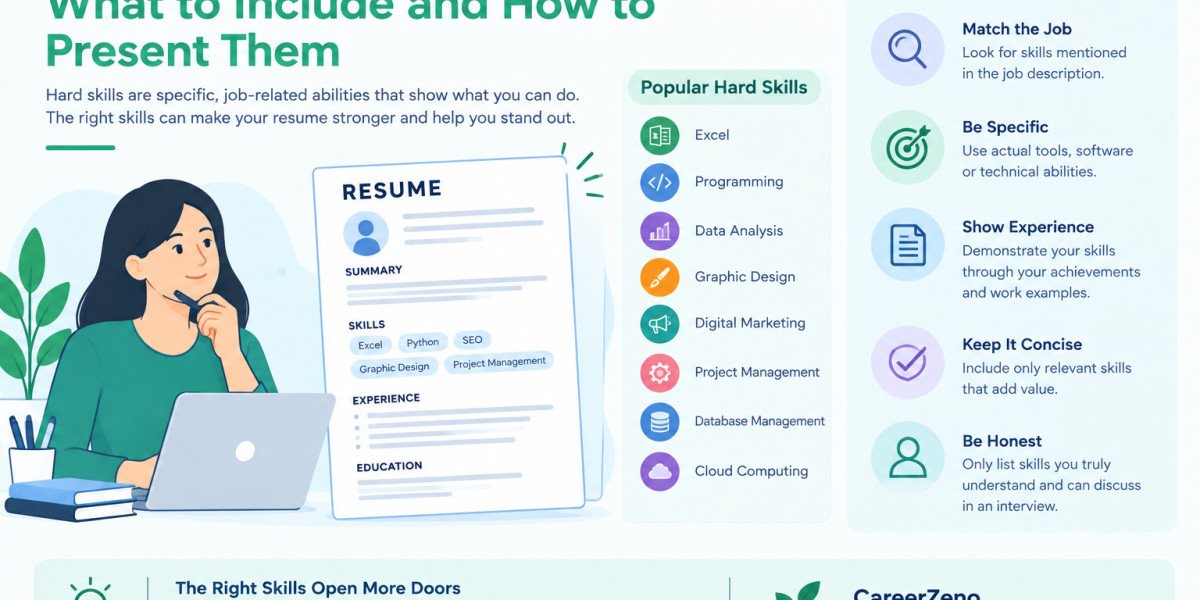
Match the job: Prioritize skills that relate directly to the position.
Be specific: Name the actual software, technology, method, or technical ability instead of using vague terms.
Show experience: Whenever possible, demonstrate important skills through your work achievements.
Keep it concise: Avoid filling your resume with an unnecessarily long list.
Be honest: Only include skills you genuinely understand and can discuss during an interview.
Hard Skills vs. Soft Skills
Hard skills are specific and measurable abilities, while soft skills relate more to personal and interpersonal qualities.
For example:
Hard skills: SQL, Excel, SEO, Python, accounting, graphic design.
Soft skills: Communication, teamwork, leadership, adaptability, and problem-solving.
A strong resume can include both, but the hard skills should be selected according to the requirements of the target position.
How CareerZeno Can Help
Choosing the right hard skills for resume content can be challenging, especially when you're applying for different positions. CareerZeno provides AI-powered career tools that can help job seekers create professional resumes and present their qualifications more effectively.
Whether you're a student, recent graduate, or experienced professional, CareerZeno can help you organize your skills and experience for your career goals.
Final Thoughts
The best hard skills for resume sections are not the longest ones. They are the most relevant and specific.
Review the job description, identify the technical skills that match your experience, and demonstrate those abilities through your achievements whenever possible. A focused skills section can make your resume easier to understand and more relevant to the position you're targeting.
For professional resume support and career-focused tools, CareerZeno helps job seekers build stronger resumes and present their skills more effectively.