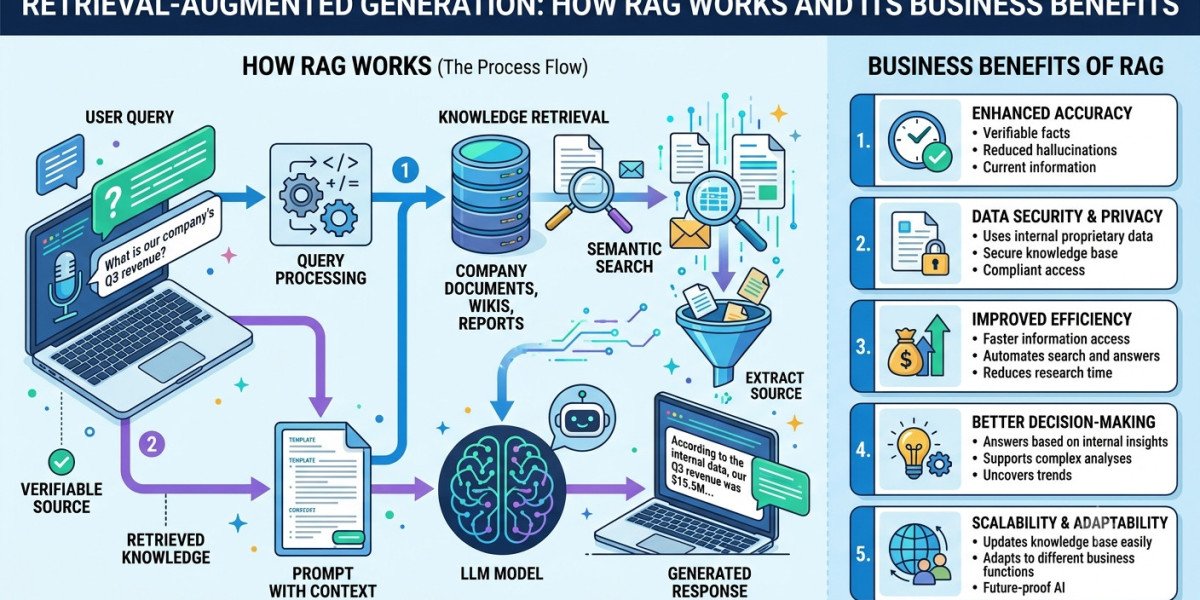

AI is now being incorporated into business operations, from customer service to document analysis and employee assistance. However, a generative AI model might lack access to the latest or proprietary information of a company. This is where retrieval-augmented generation (RAG) comes into play because it enables the AI system to retrieve pertinent data from an external source before answering the query.
RAG enables businesses to create applications based on proprietary knowledge, documents, and constantly evolving information.
What Is a RAG in AI?
Searching the meaning of "what is a RAG in AI?" RAG is short for retrieval-augmented generation. It is a technology that combines a generative AI model with an external information source.
When the user poses a question, the system scans its knowledge base to find information related to the user's question. The retrieved information is passed to the AI model, which generates the response based on that information.
For instance, a company can connect its product manuals and documentation to a RAG application. Thus, when a customer poses a question regarding the product, the system can use the retrieved information to generate the answer.
Meaning and Definition of RAG
The meaning of the RAG term can be explained by the following three components:
Retrieval: Information is retrieved from the external source.
Augmentation: Retrieved information is added to the context of the AI model.
Generation: A reply is generated based on the current context.
Thus, we can provide the following RAG definition: It is a technique that enriches generative AI by retrieving relevant external information prior to responding.
How Does RAG Pipeline Function?
As a rule, there are a number of connected stages of a typical RAG pipeline.
Data Preparation
Information from various sources, including business documents, web pages, databases, PDFs, and others, is collected and prepared. As a rule, large documents are split into small chunks in order to retrieve them better.
Information Indexing
Prepared content is indexed in the retrieval system. There are various methods of indexing depending on the specific application (keyword search, vector search, and others).
User Query
The system analyzes user queries and looks for relevant information in the available knowledge sources.
Content Retrieval
Information that is relevant to the query of the user is selected by the system and provided as additional context to the generative AI model.
Response Generation
Based on the retrieved context, the AI model generates an answer to the question. This way, the response can be associated with the company’s data.
Benefits of AI RAG for Companies
The AI RAG approach can be helpful for companies that require the use of AI in dealing with specific, proprietary, and constantly changing information. Typical use cases involve customer support, employee assistance, document search, research, and knowledge management.
The other benefit is an easy way to update information. If there is a RAG model in place, the company is able to update the knowledge base to which the model has access if the information changes, rather than relying on the training data only.
Conclusion
Retrieval-augmented generation represents a good solution for combining generative AI with external information. Due to the ability of the RAG model to retrieve relevant information first and then generate a response, companies can develop knowledge-based applications with specific data in mind.
Visit us:https://dataqix.com/retrieval-augmented-generation/