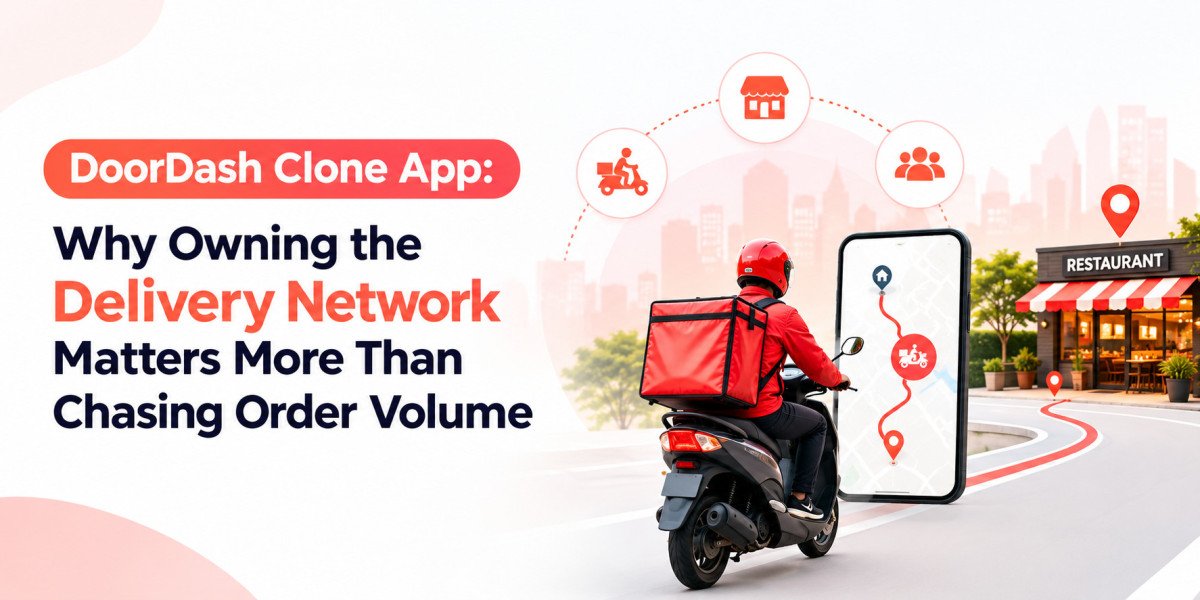

Getting more food orders sounds like the obvious goal when launching a delivery business.
But for entrepreneurs, order volume alone doesn't build a sustainable marketplace.
What matters is what happens behind every order—how efficiently restaurants receive demand, how productively delivery partners complete trips, how often customers return, and how much value the platform creates from each transaction.
That is why building a DoorDash clone app can be less about copying an existing food delivery model and more about creating your own delivery network.
Build a Network, Not Just an Ordering App
A successful delivery marketplace connects three sides:
Customers. Restaurants. Delivery partners.
Each side strengthens the other.
More restaurants give customers greater choice.
More customers create more orders for restaurants.
More orders create better earning opportunities for delivery partners.
And a stronger delivery network makes the platform more attractive to new restaurants.
For entrepreneurs, this network effect can become more valuable than simply spending more on customer acquisition.
Make Every Delivery More Productive
Higher order volume can also create operational pressure.
If delivery partners travel long distances between orders, restaurants experience pickup delays, or orders are assigned inefficiently, additional transactions don't necessarily translate into better margins.
This is where technology becomes part of the business strategy.
A modern DoorDash-style platform can use automated dispatch, route optimization, demand forecasting, and real-time tracking to coordinate orders more efficiently. SpotnEats' platform includes AI route optimization, smart demand forecasting, automated delivery-partner dispatch, and real-time order tracking.
The objective is simple:
Get more value from the delivery capacity you already have.
The First Order Shouldn't Be the Last
Acquiring a customer is only one part of the business.
The bigger opportunity is encouraging that customer to order again.
Personalized restaurant recommendations, favorite lists, order history, targeted offers, loyalty programs, subscriptions, and convenient reordering can create more reasons to return.
Instead of continuously paying to acquire new users, entrepreneurs can build a marketplace where existing customers generate recurring order value.
Don't Depend on One Revenue Stream
A delivery marketplace can generate revenue from more than restaurant commissions.
Entrepreneurs can combine:
- Restaurant commissions
- Delivery fees
- Customer subscriptions
- Sponsored restaurant listings
- In-app advertising
- Surge or demand-based pricing
SpotnEats' DoorDash clone supports these revenue models, giving entrepreneurs flexibility to build a monetization strategy around their target market.
This diversification can become especially useful as the platform scales.
Food Can Be the Starting Point, Not the Finish Line
Once the delivery infrastructure is established, entrepreneurs don't have to stop at restaurant meals.
The same marketplace can expand into grocery, bakery, flower, pharmacy, fuel, and other local delivery categories. SpotnEats positions its DoorDash clone as customizable for multiple delivery models.
That creates a larger opportunity:
Start with food. Build the network. Expand the categories.
Build Your Own Delivery Network With SpotnEats
Launching a delivery marketplace from scratch means developing customer, restaurant, delivery-partner, and admin systems while connecting payments, tracking, dispatch, analytics, and notifications.
A ready-made DoorDash clone app gives entrepreneurs a prebuilt foundation that can be branded and customized around their business model. SpotnEats offers native customer and delivery apps, restaurant interfaces, admin dashboards, AI-driven capabilities, multiple payment options, multilingual and multicurrency support, and customization options.
The real opportunity isn't to build another DoorDash.
It's to build your own delivery network—one that owns the customer relationship, controls the marketplace, and gives you room to expand beyond food.