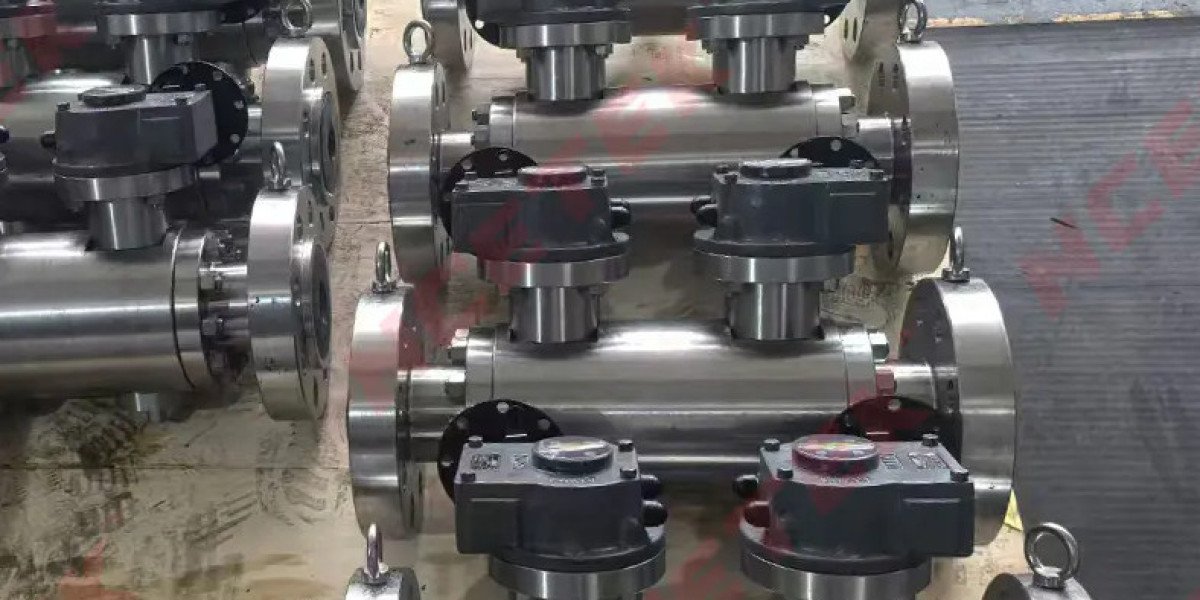

Industrial pipeline systems often require valve structures that can accommodate mechanical loads while providing controlled isolation of process media. A Cast Steel Trunnion Mounted Ball Valve combines a cast steel body with a supported ball mechanism, creating a configuration used across energy, petrochemical, industrial processing, and pipeline applications. Its suitability depends on body construction, ball support, sealing components, machining accuracy, operating mechanisms, and inspection procedures.
The cast steel body provides the structural foundation of the valve. Casting technology allows manufacturers to produce complex body configurations and internal passages while supporting different connection arrangements. Material selection should be based on pressure, temperature, corrosion exposure, process medium, and expected operating cycles. Different steel grades may be considered when specific mechanical or corrosion-related characteristics are required.
Casting process control is important because the body must withstand the mechanical and pressure conditions associated with its intended application. Mold preparation, molten metal control, cooling, finishing, and inspection can all affect the finished component. Before machining, manufacturers may examine the cast body for surface conditions and dimensional consistency, with additional inspection methods applied where project requirements call for them.
The trunnion-mounted structure provides fixed support for the ball. Unlike a floating arrangement, the ball is supported by trunnion components within the valve body. This configuration can distribute mechanical loads through the valve structure and influence the torque required for operation. The support mechanism also needs to be manufactured with appropriate dimensional accuracy so that the ball remains correctly positioned during opening and closing.
Machining accuracy is critical to the complete assembly. The valve body, ball, trunnion components, stem, and sealing surfaces must maintain suitable dimensional relationships. Computer-controlled machining can support repeatable production, while inspection equipment verifies critical dimensions. Surface finishing around sealing interfaces is particularly important because the quality of these surfaces can affect seat contact and leakage control.
Seat design should reflect the actual service conditions. Soft sealing materials may be suitable for certain applications, while metal-seated arrangements can be considered for services involving elevated temperatures or other demanding conditions. Material compatibility with the process medium should be assessed together with pressure, temperature, operating frequency, and potential contamination.
The stem and actuator system also influence valve operation. The stem transfers rotational movement to the ball, requiring accurate alignment and suitable mechanical strength. Stem seals provide an important barrier between the internal process environment and the outside of the valve. For automated applications, actuator selection should correspond with operating torque, cycling frequency, control requirements, and available installation space.
Pipeline connections must be selected according to system requirements. Flanged and welded arrangements may serve different installation and maintenance strategies. Engineers should consider pipeline alignment, support structures, valve orientation, actuator access, and available maintenance space. Large industrial valves may also require specific lifting and handling procedures during installation.
Quality assurance should cover the complete production process. Material verification, casting inspection, dimensional checks, machining inspection, assembly control, pressure testing, leakage testing, and operational verification can each contribute to finished-product quality. Maintaining records from these stages can provide useful traceability for industrial projects and future maintenance.
External protection may be necessary for valves operating outdoors or in corrosive environments. Coatings and other protective treatments should be compatible with the selected body material and surrounding conditions. Maintenance programs can include inspection of external surfaces, operating components, connections, and accessible sealing areas according to system requirements.
When selecting a Cast Steel Trunnion Mounted Ball Valve, engineering teams should evaluate the cast body, supported ball structure, seat materials, stem configuration, actuator compatibility, connection design, testing procedures, corrosion protection, and maintenance conditions together. Industrial ball valve products and related solutions can be reviewed through https://www.ncevalve.com/product/ when matching valve construction with different pipeline and process requirements.