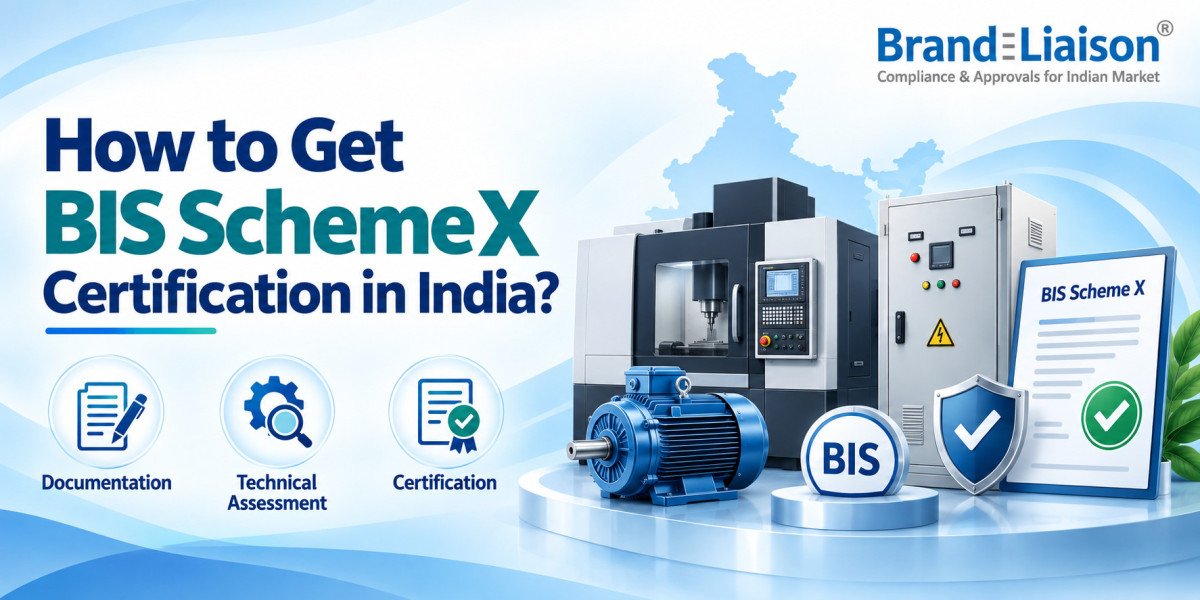

BIS Scheme X Certification is a conformity assessment route under the BIS (Conformity Assessment) Regulations, 2018. It applies to products that have been specifically brought under Scheme X through applicable government notifications and Quality Control Orders (QCOs).
For manufacturers, obtaining BIS Scheme X Certification in India generally involves identifying the applicable Indian Standard, preparing the manufacturing and testing facilities, submitting a technical file, product testing, factory assessment and fulfilling BIS requirements before the licence to use the Standard Mark is granted.
BIS states that manufacturers applying under Scheme X must have the required manufacturing infrastructure, in-process controls, quality-control arrangements and testing capabilities for the relevant product.
Brand Liaison assists manufacturers with BIS Scheme X Certification, including applicability assessment, documentation, laboratory coordination, application support and certification-related compliance.
What is BIS Scheme X Certification?
Scheme X is a BIS conformity assessment scheme under Schedule II of the BIS (Conformity Assessment) Regulations, 2018.
It is used for products covered by applicable government notifications requiring BIS certification under Scheme X.
The Government can make compliance with specified Indian Standards mandatory through Quality Control Orders. BIS maintains a list of products covered under compulsory certification, including products falling under Scheme X.
The scope of Scheme X has expanded beyond its earlier applications. Current BIS information includes products such as certain low-voltage switchgear and controlgear and machinery/electrical equipment covered under applicable regulatory orders.
Therefore, businesses should always verify the current QCO, applicable Indian Standard and implementation date for their specific product.
Who Needs BIS Scheme X Certification?
BIS Scheme X Certification is relevant to manufacturers whose products are covered under a government notification requiring certification under Scheme X.
It can apply to:
- Indian manufacturers
- Foreign manufacturers
- Manufacturers of notified machinery and electrical equipment
- Manufacturers of specified low-voltage switchgear and controlgear
- Other manufacturers whose products are brought under Scheme X through applicable regulations
Importers, distributors and retailers do not normally obtain the BIS manufacturing licence themselves. The BIS licence is associated with the manufacturing premises. BIS specifically states that separate certification is required for each manufacturing location.
Why is BIS Scheme X Certification Important?
For products covered by a mandatory QCO, obtaining the applicable BIS certification is a regulatory requirement.
BIS explains that, after the effective date of a QCO, products covered by it cannot generally be manufactured, imported, distributed, sold, hired, leased, stored or exhibited for sale without the prescribed Standard Mark under a valid BIS licence.
BIS Scheme X Certification can help manufacturers:
- Meet applicable mandatory requirements
- Demonstrate conformity with Indian Standards
- Obtain authorization to use the applicable Standard Mark
- Support legal market entry for regulated products
- Establish manufacturing and quality-control systems
- Demonstrate product conformity through testing and assessment
How to Get BIS Scheme X Certification in India?
The exact procedure depends on the product, Indian Standard and applicable product-specific guidelines. However, the general process includes the following stages.
Step 1: Check Whether BIS Scheme X Applies
Before starting the application, determine whether your product is covered under Scheme X.
Check:
- Product category
- Applicable QCO
- Indian Standard
- Implementation date
- Product scope
- Applicable conformity assessment requirements
BIS maintains the current list of products under compulsory certification and Scheme X.
This step is particularly important because not every product requires Scheme X Certification.
Step 2: Identify the Applicable Indian Standard
After confirming Scheme X applicability, identify the Indian Standard applicable to the product.
The manufacturer should review:
- Product specifications
- Technical requirements
- Testing requirements
- Applicable product manual
- Scope of certification
- Scheme of Inspection and Testing
BIS provides product-specific manuals containing information such as testing equipment, sampling requirements, scope and Scheme of Inspection and Testing.
Step 3: Review the Product Manual and BIS Scheme X Requirements
The manufacturer should review the relevant BIS product manual before applying.
The product manual can provide important information regarding:
- Scope of licence
- Product varieties
- Test requirements
- Sampling guidelines
- Testing facilities
- Inspection requirements
- Quality-control arrangements
- Scheme of Inspection and Testing
This helps the manufacturer understand what needs to be prepared before the BIS assessment.
Step 4: Prepare the Manufacturing Facility
Scheme X is not simply a product-testing exercise.
BIS states that a manufacturer must have the requisite manufacturing infrastructure, in-process controls, quality control and testing capabilities for the product.
Depending on the product, the factory may need appropriate:
- Manufacturing machinery
- Production facilities
- Inspection facilities
- Testing equipment
- Quality-control systems
- Trained technical personnel
- Calibration arrangements
- Raw-material controls
- Finished-product inspection systems
The exact requirements depend on the relevant Indian Standard and product manual.
Step 5: Prepare the Technical File
One of the important requirements under Scheme X is the Technical File.
According to BIS, a technical file covers documentation relating to the design, manufacture and operation of the product to the extent necessary for demonstrating conformity. BIS also states that an application under Scheme X should not be submitted without the required technical file.
The technical file may include information such as:
- Product design information
- Technical specifications
- Drawings
- Manufacturing information
- Components/material details
- Product characteristics
- Testing information
- Risk or safety-related information, where applicable
- Other technical documents specified in the product manual
The exact contents should be prepared according to the applicable product requirements.
Step 6: Product Testing
Product testing is an important part of the Scheme X certification process.
BIS indicates that conformity can be established through:
- Testing at a BIS laboratory
- Testing at a BIS-recognized third-party laboratory
- Testing at the manufacturer's facility, where permitted
- A combination of these methods
The applicable route depends on the product and certification procedure.
Testing may cover parameters specified in the relevant Indian Standard.
Step 7: Submit the BIS Scheme X Application
After preparing the required documents, technical file, testing arrangements and factory facilities, the manufacturer can submit the applicable BIS application.
The application generally contains information relating to:
- Manufacturer
- Manufacturing premises
- Product
- Indian Standard
- Product varieties
- Manufacturing process
- Testing facilities
- Quality-control arrangements
- Technical file
- Supporting documents
BIS provides online application facilities for applicable certification processes, while the exact application route can depend on the product and manufacturer category.
Step 8: BIS Factory Assessment
BIS assesses the manufacturing premises to determine whether the manufacturer has the necessary capabilities to consistently produce conforming products.
During the assessment, BIS may examine:
- Manufacturing infrastructure
- Production processes
- Quality-control procedures
- Testing facilities
- Testing equipment
- Calibration records
- Technical personnel
- Raw-material controls
- Finished-product controls
- Technical documentation
BIS confirms that licensing decisions are based on assessment of manufacturing infrastructure, process controls, quality control and testing capabilities, along with establishing conformity of the product to the applicable standard.
Step 9: Witness Testing or Sample Testing
Depending on the applicable Scheme X procedure, testing may be witnessed by BIS officials or carried out through an accepted laboratory/testing arrangement.
BIS's Scheme X FAQ describes two routes, including testing at BIS/BIS-approved third-party laboratories and witnessing complete testing, including applicable subcontracted facilities.
For long-duration tests, BIS also provides specific arrangements under its Scheme X procedure.
Step 10: Resolve Observations or Non-Conformities
If BIS identifies deficiencies during document review, testing or factory assessment, the manufacturer may need to take corrective action.
Possible issues can include:
- Missing technical documentation
- Inadequate testing facilities
- Product non-conformity
- Calibration issues
- Manufacturing-control gaps
- Incomplete records
- Documentation discrepancies
The manufacturer must address applicable observations before certification can be completed.
Step 11: Grant of BIS Scheme X Licence
After successful completion of the applicable assessment, testing and other requirements, BIS can grant the licence.
The licence specifies the applicable scope, including relevant product and Indian Standard details.
The manufacturer can then use the BIS Standard Mark according to the conditions of the licence and applicable marking requirements.
Documents Required for BIS Scheme X Certification
The exact documents vary according to the product and applicable BIS product manual.
Common documents can include:
Company Documents
- Company registration documents
- Manufacturer details
- Factory address
- Authorized signatory information
- Contact details
Technical Documents
- Product specifications
- Product drawings
- Technical datasheets
- Product photographs
- Component/material details
- Manufacturing process information
- Technical File
Factory Documents
- Factory layout
- Machinery details
- Manufacturing process flow
- Production capacity
- Testing equipment list
- Calibration records
- Quality-control procedures
Testing Documents
- Test reports
- In-house test records, where applicable
- Laboratory details
- Calibration certificates
- Testing procedures
Other Documents
- Trademark/brand documents, where applicable
- Authorization documents
- Undertakings and declarations
- Documents specified in the applicable product manual
BIS Scheme X Certification Cost in India
The BIS Scheme X Certification cost in India varies depending on the product and certification requirements.
There is no single fixed cost for all Scheme X products.
The overall cost can include:
- BIS application and processing fees
- Product testing charges
- Laboratory charges
- Factory assessment-related expenses
- Testing equipment requirements
- Calibration expenses
- Documentation costs
- Professional consultancy charges
BIS maintains a specific fee framework for Scheme X and has issued fee notifications and amendments, including an amendment dated March 17, 2026.
Therefore, manufacturers should calculate the cost based on the specific product, Indian Standard and manufacturing facility.
How Long Does BIS Scheme X Certification Take?
The timeline varies depending on:
- Product category
- Applicable Indian Standard
- Testing duration
- Laboratory availability
- Factory readiness
- Technical file preparation
- BIS assessment schedule
- Product varieties
- Corrective actions
- Queries raised during assessment
Long-duration tests can particularly affect the overall timeline. BIS has specific provisions for products involving tests with extended durations.
BIS Scheme X Certification for Foreign Manufacturers
Foreign manufacturers can also obtain BIS certification for applicable products.
BIS confirms that foreign manufacturers can obtain BIS certification and provides for certification through the Foreign Manufacturers Certification Scheme (FMCS).
Foreign manufacturers may need to:
- Identify the applicable Scheme X requirement
- Identify the applicable Indian Standard
- Prepare the technical file
- Arrange required testing
- Prepare the manufacturing facility
- Nominate an Authorized Indian Representative (AIR), where required
- Submit the application
- Undergo factory assessment
- Address observations
- Obtain the BIS licence
BIS's foreign-manufacturer guidance specifies requirements relating to an Indian resident Authorized Indian Representative for applicable Scheme X/FMCS arrangements.
Does Each Factory Need a Separate BIS Scheme X Certificate?
Yes.
BIS states that certification is granted to the manufacturing premises, rather than simply to the company. Therefore, separate certification is required for separate manufacturing locations.
For example, if a company has three factories producing the same product at three different locations, the certification requirements need to be considered separately for each manufacturing premises.
Can One BIS Scheme X Licence Cover Different Products?
Not necessarily.
BIS states that separate licences are granted for different products according to the applicable Indian Standards. However, different varieties of the same product may be covered under one licence depending on the applicable product-specific guidelines and grouping provisions.
Therefore, manufacturers should review the relevant product manual and scope/grouping guidelines before applying.
BIS Scheme X Certification vs BIS ISI Certification
Scheme X and the traditional BIS ISI certification route are both conformity assessment mechanisms, but they are not identical.
Scheme X applies to products specifically covered by the relevant Scheme X requirements and notifications.
Scheme I is the traditional BIS product certification scheme associated with the ISI Mark for applicable products.
The applicable scheme depends on the product, Indian Standard and government notification.
Manufacturers should therefore identify the correct BIS certification route before starting testing or submitting an application.
Common Mistakes to Avoid
Manufacturers should be careful about the following issues:
1. Starting Without Checking the QCO
First confirm whether the product is actually covered and when the requirement becomes effective.
2. Choosing the Wrong Indian Standard
The correct Indian Standard is the foundation of the certification process.
3. Submitting an Incomplete Technical File
BIS specifically states that applications under Scheme X should not be submitted without the required technical file.
4. Ignoring Factory Requirements
Having a compliant product alone may not be sufficient. Manufacturing infrastructure, process controls, quality control and testing capabilities are important.
5. Using an International Test Certificate as a Substitute
BIS states that certification against an international standard does not substitute for the required BIS licence under Scheme X where the applicable QCO requires conformity to the specified Indian Standard.
6. Not Preparing for Factory Assessment
The manufacturing facility and testing arrangements should be ready before the BIS assessment.
Why Choose Brand Liaison for BIS Scheme X Certification?
Brand Liaison provides professional assistance for BIS certification and product compliance requirements in India.
With 12 years of experience in compliance certification and support for 500+ manufacturers, Brand Liaison assists businesses in navigating the BIS certification process.
Our BIS Scheme X Certification assistance can include:
- Scheme X applicability assessment
- Indian Standard identification
- Product manual review
- Technical File documentation support
- Laboratory coordination
- Product testing assistance
- Factory readiness guidance
- BIS application support
- Factory inspection preparation
- Query and clarification support
- Certification compliance guidance
Brand Liaison also assists manufacturers with other Indian compliance requirements, including BIS ISI Certification, BIS CRS Registration, WPC ETA, BEE Registration, TEC/MTCTE, EPR and LMPC, depending on the product and applicable regulations.
Frequently Asked Questions
What is BIS Scheme X Certification?
BIS Scheme X Certification is a conformity assessment route under the BIS (Conformity Assessment) Regulations, 2018, applicable to products covered under relevant Scheme X notifications and requirements.
Is BIS Scheme X Certification mandatory?
It is mandatory where a government notification/QCO requires the applicable product to comply with BIS certification under Scheme X. The current QCO and implementation date should be checked for the specific product.
Who can apply for Scheme X Certification?
Manufacturers can apply for the applicable BIS certification. Foreign manufacturers can also obtain certification through the applicable FMCS arrangements.
Is a Technical File required?
Yes. BIS states that an application for grant of licence under Scheme X should not be submitted without the required Technical File.
Is factory inspection required?
Factory assessment is an important part of the Scheme X certification process because BIS assesses manufacturing infrastructure, process controls, quality control and testing capabilities.
Can a foreign manufacturer get Scheme X Certification?
Yes. Foreign manufacturers can obtain BIS certification under applicable FMCS arrangements, subject to the relevant requirements and documentation.
How much does BIS Scheme X Certification cost?
The cost varies by product, testing requirements, BIS fees, factory assessment and other compliance expenses. BIS publishes the applicable Scheme X fee framework.
Conclusion
Getting BIS Scheme X Certification in India involves more than submitting a product test report. Manufacturers need to demonstrate conformity with the applicable Indian Standard and meet requirements relating to manufacturing infrastructure, process controls, quality control, testing capabilities and technical documentation.
The general process includes checking the applicable QCO, identifying the Indian Standard, preparing the factory, creating the Technical File, completing product testing, submitting the application, undergoing factory assessment, resolving observations and obtaining the BIS licence.
Because Scheme X requirements are product-specific and regulatory notifications can be amended, manufacturers should verify the latest BIS requirements before beginning the certification process.
Brand Liaison provides end-to-end assistance for BIS Scheme X Certification in India, helping manufacturers with applicability assessment, documentation, testing coordination, application support and certification-related compliance.
BIS ISI certification consultant in India
BIS ISI consultant in India
BIS ISI Certification Consultant in Delhi
BIS CRS Rertification Consultant in Delhi
WPC Certificate Consultant in Delhi
WPC ETA Certificate Consultant
BEE Certification Consultant in India
BEE Certification Consultant in Delhi
EPR certification consultant in India
EPR certification consultant in Delhi
EPR Certification for Electronic Waste
EPR Certificate for Plastic Waste
EPR Certification for Battery Waste
EPR Certification for Tyre Waste
EPR Certification for Used Oil
TEC Certification Consultant in India
TEC certification consultant in Delhi
BIS Scheme X Consultant in India