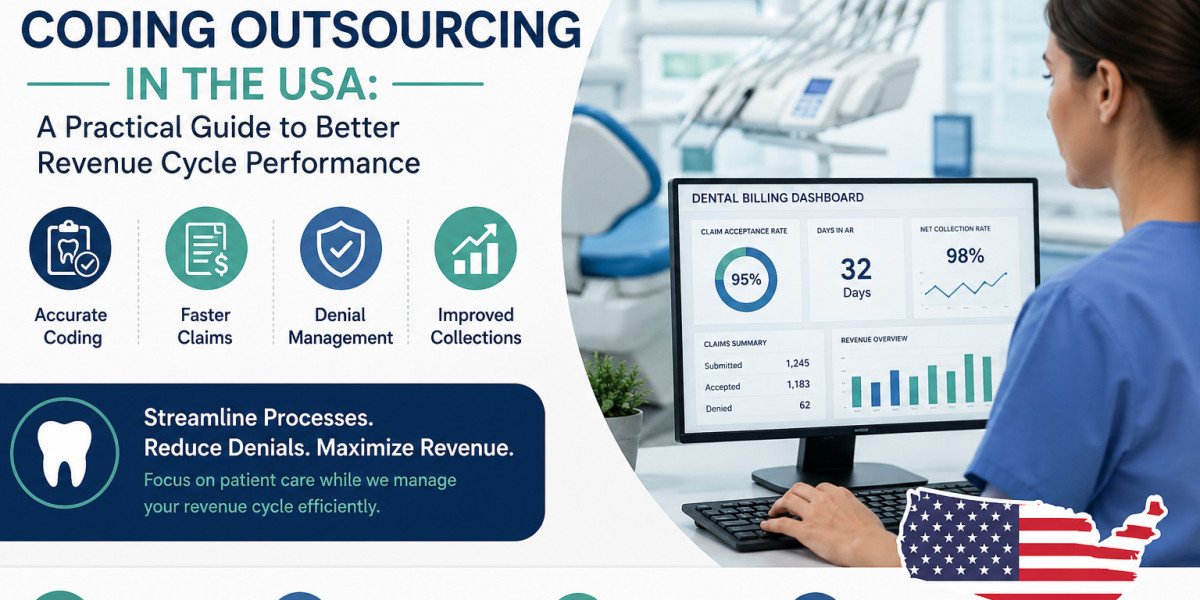

Running a dental practice involves much more than treating patients. Every appointment creates a chain of administrative and financial tasks, from verifying insurance eligibility to submitting claims, tracking payments, correcting rejected claims, and following up on unpaid balances. When these processes are handled inconsistently, revenue can remain tied up long after the patient has left the office.
This is one reason more dental practices are exploring the option to outsource dental billing USA operations to specialized professionals. Outsourcing can give dental teams access to experienced billing staff without requiring the practice to manage every part of the revenue process internally.
The goal is not simply to send claims faster. Effective dental billing requires attention to payer requirements, accurate coding, documentation, patient benefits, claim status, and accounts receivable. A well-organized billing process can help a practice reduce avoidable delays while allowing dentists and office staff to spend more time on patient care.
Why Dental Billing Has Become More Complicated
Dental billing may appear straightforward from the outside, but the financial process behind a procedure can involve several moving parts.
A typical claim may depend on:
- Correct CDT procedure coding
- Accurate patient and subscriber information
- Insurance eligibility and benefit verification
- Proper documentation
- Payer-specific requirements
- Coordination of benefits
- Preauthorization or predetermination when applicable
- Timely claim submission
- Accurate payment posting
- Follow-up on outstanding claims
Even a small mistake can affect the payment cycle. For example, an incorrect subscriber ID may cause a claim to be rejected. A missing document can delay processing. A misunderstanding of a patient's benefits may create an unexpected balance that the practice must later explain to the patient.
For busy practices, keeping track of all these details internally can become difficult.
What Does It Mean to Outsource Dental Billing in the USA?
When a practice chooses to outsource dental billing USA operations, some or all billing responsibilities are handled by an external billing specialist or organization.
The exact scope varies between providers, but outsourced dental billing may cover areas such as:
- Patient eligibility verification
- Insurance benefit checks
- Dental claim preparation
- Electronic claim submission
- Claim status monitoring
- Rejected and denied claim management
- Payment posting
- Accounts receivable follow-up
- Patient balance support
- Billing reports
- Insurance aging analysis
- Revenue cycle monitoring
Some dental practices outsource only specific tasks, while others use a more comprehensive billing model.
The important point is that outsourcing should fit the practice's workflow rather than forcing the practice into a completely different system.
Why Dental Practices Consider Outsourcing
1. Reducing Administrative Pressure
Dental teams already manage scheduling, patient communication, treatment coordination, documentation, and front-desk responsibilities.
Adding detailed billing follow-up to the same workload can create bottlenecks.
An external billing team can take responsibility for repetitive financial tasks, allowing internal employees to focus on activities that require direct patient interaction.
2. Improving Claim Accuracy
Claim errors can occur for many reasons. Incorrect information, missing details, coding mistakes, or payer-specific requirements can all contribute to delays.
Experienced dental billing providers generally use established workflows for reviewing claims before submission. The objective is to identify preventable problems rather than repeatedly correcting them after rejection.
3. Better Accounts Receivable Follow-Up
Submitting a claim is only one part of the revenue process.
A practice also needs to know:
- Which claims are still pending?
- Which claims were denied?
- Which accounts have aged beyond normal payment periods?
- Which payer is responsible for a delayed payment?
- Which patient balances require follow-up?
Consistent follow-up can prevent older accounts from being overlooked.
4. Access to Specialized Knowledge
Dental billing rules and payer processes can change. An outsourced team that works with multiple practices may encounter a wider range of billing situations than an individual employee working only within one office.
This experience can be useful when dealing with unusual claim scenarios, payer responses, coordination-of-benefits issues, or recurring rejection patterns.
What to Look for in Dental Billing Companies
Not every billing company provides the same level of service. Before choosing among dental billing companies, a practice should evaluate how the company actually manages the revenue cycle.
Experience With Dental Practices
Dental billing is different from general medical billing. A provider should understand dental procedures, CDT coding, dental insurance terminology, and the operational realities of dental practices.
Ask whether the company has experience with practices similar to yours, including your specialty, practice size, and payer mix.
Transparent Workflow
A good billing partner should be able to explain what happens after a claim leaves the practice.
For example:
Patient visit → Eligibility verification → Documentation review → Claim preparation → Submission → Payer response → Payment posting → Denial follow-up → A/R monitoring
A clearly defined workflow makes accountability easier.
Reporting and Visibility
Outsourcing should not mean losing visibility into financial performance.
Useful reporting may include:
- Claims submitted
- Claims rejected
- Denials
- Payments received
- Outstanding accounts receivable
- Aging by payer
- Aging by patient
- Collection trends
- Unresolved claim volume
Regular reporting helps the practice understand whether the billing process is improving or where additional attention is needed.
Understanding Dental Billing RCM
Dental billing RCM refers to the financial process that begins when a patient receives care and continues until the practice receives the appropriate payment.
Revenue cycle management can involve several connected stages.
Before the Appointment
The process can begin before treatment takes place. Eligibility verification and benefit checks help the practice understand the patient's coverage and communicate financial expectations.
During the Patient Visit
Accurate documentation and procedure information are essential. The information captured at this stage eventually supports the claim.
After Treatment
The billing team prepares and submits the claim, monitors payer responses, and addresses problems when they occur.
During Payment Processing
Payments need to be posted accurately. Any remaining balance should be reviewed according to the patient's insurance responsibility and the practice's policies.
During A/R Follow-Up
Outstanding claims and balances should be monitored rather than allowed to remain unresolved indefinitely.
This complete approach is what makes dental billing RCM different from simply submitting claims.
The Role of Coding in Dental Revenue
Coding accuracy has a direct relationship with the billing process. A procedure must be represented accurately based on the services documented by the dental provider.
Although dental practices primarily work with dental coding systems, some organizations also operate across healthcare billing environments. This is where broader expertise in medical coding services can become useful, particularly for organizations managing both dental and medical-related billing workflows.
Similarly, medical billing and coding services may be relevant for healthcare organizations with multiple revenue streams or practices that coordinate dental and medical services.
The underlying principle remains the same: coding should accurately represent the documented service and support appropriate claim processing.
Dental Billing Companies in the USA: Questions to Ask Before Choosing One
Before signing an agreement with dental billing companies in USA, practice owners should look beyond the advertised percentage or monthly fee.
Consider asking:
- Which billing tasks are included?
- How are rejected claims handled?
- Who follows up on unpaid claims?
- How frequently are A/R reports provided?
- Can the billing team work with the practice's existing software?
- How are patient balances handled?
- How is billing performance measured?
- What happens when a payer changes its requirements?
- Who is the main point of contact?
- How is patient and financial information protected?
The answers can reveal whether a company is genuinely equipped to manage the practice's billing workload.
When Outsourcing May Make More Sense Than Hiring Internally
Hiring an internal billing specialist can work well for some practices. However, there are situations where outsourcing becomes attractive.
For example, consider a growing dental practice where patient volume has increased significantly. The front office is busy, claims are accumulating, and the dentist does not want to add another full-time employee solely for billing.
An external billing team may provide additional capacity without requiring the practice to build an entire internal billing department.
Outsourcing can also be considered when:
- The existing billing employee is overloaded
- A practice is experiencing high A/R
- Denials are increasing
- Claims are not being followed up consistently
- Billing staff turnover is affecting collections
- The practice is expanding into additional locations
- Management wants more structured financial reporting
However, outsourcing is not automatically the right answer for every practice. The expected value should be compared with the cost and the level of service provided.
What a Strong Dental Billing Company Services Model Looks Like
A comprehensive dental billing company services model should connect individual billing tasks instead of treating them as isolated activities.
For example, eligibility verification should support accurate patient estimates. Accurate documentation should support clean claims. Claim monitoring should identify unpaid accounts. Payment posting should help maintain accurate A/R. A/R analysis should then reveal where recurring problems exist.
This creates a feedback loop.
If one payer repeatedly rejects claims for the same reason, the solution should not simply be to correct each claim individually. The billing team should identify the pattern and determine whether something in the workflow needs to change.
That type of analysis can provide greater long-term value than simply increasing the number of claims submitted.
Connecting Dental Billing With Broader Healthcare Revenue Services
Some healthcare organizations require services that extend beyond dental billing. Depending on their operations, they may also need medical billing services, particularly when medical and dental workflows coexist.
Organizations may also use revenue cycle management services to coordinate broader financial processes, including claim management, payment posting, denial follow-up, and accounts receivable monitoring.
Another related area is credentialing services. Keeping provider enrollment and payer participation information organized can help prevent administrative problems that may interfere with reimbursement.
These services do not replace dental billing expertise. Instead, they can complement it when an organization manages multiple healthcare revenue processes.
A Practical Example
Imagine a multi-provider dental practice that sees hundreds of patients each month.
The front desk verifies insurance, but because of workload, some benefit checks are completed late. Claims are submitted, but there is no consistent process for reviewing rejected claims. Payments arrive, but older accounts are not always followed up.
The practice may appear busy while still experiencing unnecessary revenue delays.
After reorganizing its billing workflow, the practice could establish clear ownership for eligibility, claim submission, rejection handling, payment posting, and A/R follow-up.
The objective is not simply to "bill more." It is to create a process where fewer claims fall through the cracks and unresolved accounts receive timely attention.
How to Measure Outsourced Billing Performance
A practice should establish measurable expectations before outsourcing.
Potential indicators include:
- Claim rejection rate
- Denial rate
- Days in accounts receivable
- Aging A/R
- Clean claim performance
- Payment posting turnaround
- Outstanding claim volume
- Collection trends
- Unresolved insurance balances
These metrics should be reviewed over time rather than judged from one reporting period.
A billing partner should also explain why a metric changed. For example, an increase in A/R might be related to payer delays, higher patient volume, changes in insurance mix, or workflow problems. Numbers are more useful when they lead to actionable insight.
Conclusion
Choosing to outsource dental billing USA operations can be a practical way for dental practices to reduce administrative pressure and create a more consistent revenue process. The real benefit comes from having a structured workflow that covers claims, payments, denials, and accounts receivable rather than treating billing as a single administrative task.
When evaluating dental billing services company options, practices should focus on dental experience, transparent processes, reporting, communication, technology compatibility, and measurable performance.
For practices looking for broader healthcare support, 247 Medical Billing Services provides services across areas such as medical billing services, medical coding services, medical billing and coding services, revenue cycle management services, and credentialing services. The right partner should ultimately complement the practice's existing team and help create a billing process that is accurate, organized, and easier to manage as the practice grows.
FAQs
1. What does it mean to outsource dental billing in the USA?
It means hiring an external billing provider to manage some or all financial and insurance-related billing activities for a dental practice. Services can include claims, eligibility verification, payment posting, denial management, and accounts receivable follow-up.
2. What services do dental billing companies typically provide?
Dental billing companies may provide eligibility verification, claim preparation and submission, rejection management, payment posting, insurance follow-up, patient balance support, A/R management, and financial reporting.
3. Can outsourcing help reduce dental claim delays?
It can. A structured billing workflow may help identify missing information, submission errors, unresolved rejections, and unpaid claims more consistently. Results depend on the provider's processes and the practice's documentation and workflow.
4. How should a dental practice choose a billing provider?
The practice should evaluate dental billing experience, services included, communication, reporting, technology compatibility, security practices, A/R processes, and performance measurements rather than selecting a provider based only on price.
5. Is dental billing the same as medical billing?
No. Dental billing has its own coding, procedures, insurance structures, and payer processes. Providers working across both environments need to understand the differences rather than applying a generic medical billing workflow to dental claims.
6. What is dental billing RCM?
Dental billing RCM, or dental revenue cycle management, covers the financial process from patient registration and insurance verification through claim submission, payment posting, denial management, and accounts receivable follow-up.