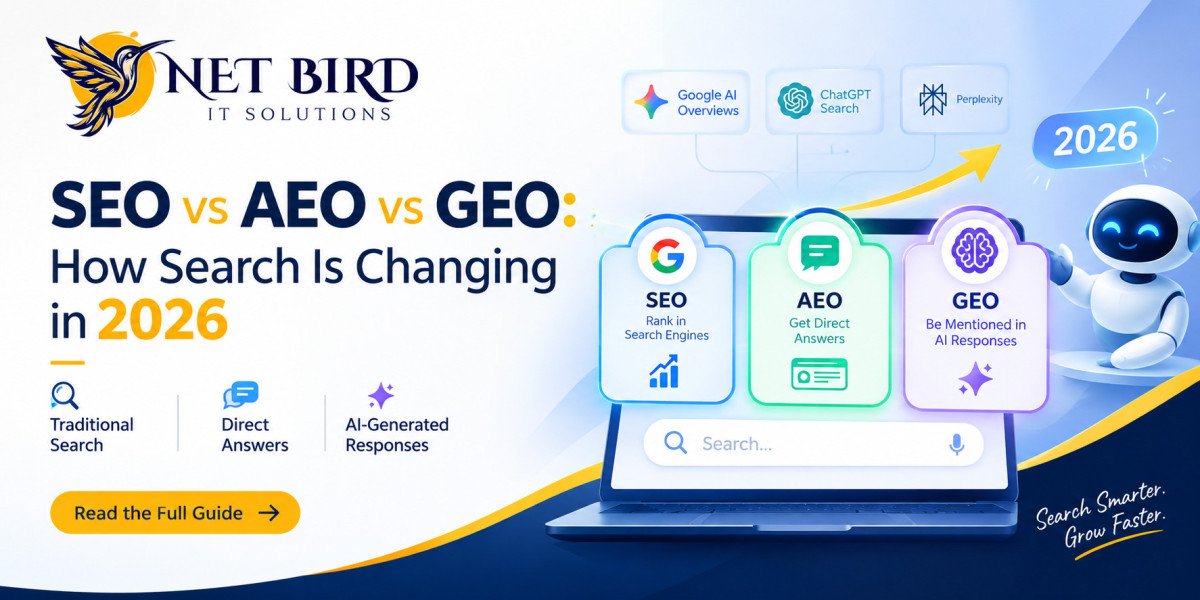

SEO vs AEO vs GEO: How Search Is Changing in 2026
If you've been managing a website in the last two years, you've probably noticed something strange happening to your traffic. Rankings look fine, but clicks are down. That's because search itself has split into three distinct battlegrounds: traditional search engines, answer engines, and generative AI engines.
This has given rise to a real, practical debate — SEO vs AEO vs GEO — and it's no longer just industry jargon. Google's AI Overviews, ChatGPT Search, and Perplexity are actively rewriting how people find information, and each one rewards content differently.
At Net bird IT Solution, we work with brands every day who ask the same question: "We already do SEO — do we need AEO and GEO too?" The short answer is yes, but understanding why requires breaking each one down.
What Is SEO (Search Engine Optimization)?
Search Engine Optimization (SEO) is the practice of optimizing a website so it ranks higher on traditional search engine results pages (SERPs) like Google and Bing. It relies on:
Keyword research and on-page optimization
Backlinks and domain authority
Technical SEO (site speed, crawlability, indexing)
Content depth and topical authority
SEO is built around clicks. The goal is to get a user to leave the search engine and land on your website.
Best for: Businesses that depend on organic website traffic, e-commerce stores, service-based websites, and long-term brand visibility.
What Is AEO (Answer Engine Optimization)?
Answer Engine Optimization (AEO) focuses on getting your content featured as the direct answer to a user's question — think featured snippets, "People Also Ask" boxes, voice search results (Alexa, Siri, Google Assistant), and zero-click search results.
AEO prioritizes:
Clear, concise, question-based content structure
FAQ schema and structured data markup
Conversational, natural-language phrasing
Semantic SEO and entity optimization
Unlike SEO, AEO often results in a zero-click search — the user gets their answer without ever visiting your site. So why bother? Because AEO builds brand authority and visibility even without a click, and it often feeds directly into GEO.
Best for: Brands wanting quick visibility, voice search readiness, and featured snippet real estate.
What Is GEO (Generative Engine Optimization)?
Generative Engine Optimization (GEO) is the newest and most disruptive of the three. It's the practice of optimizing content to be cited, summarized, or referenced by generative AI tools like Google AI Overviews, ChatGPT Search, Perplexity, and Copilot.
GEO is less about ranking and more about being the source an AI trusts enough to quote. This is where AI search optimization and AI visibility become critical business metrics.
GEO relies heavily on:
Strong topical authority and comprehensive content clusters
E-E-A-T (Experience, Expertise, Authoritativeness, Trustworthiness)
Digital PR and third-party mentions across the web
Structured, fact-dense, easily "extractable" content
Original data, statistics, and unique insights AI models can't get elsewhere
Best for: Brands that want to be cited by ChatGPT, Perplexity, and AI Overviews — increasingly where high-intent buyers start their research.
SEO vs AEO vs GEO: Side-by-Side Comparison
Factor | SEO | AEO | GEO |
Goal | Rank on SERPs | Be the direct answer | Get cited by AI engines |
Platform | Google, Bing | Featured snippets, voice assistants | ChatGPT, AI Overviews, Perplexity |
Traffic outcome | Clicks to website | Often zero-click | Often zero-click, high brand recall |
Content style | Keyword-optimized | Question-and-answer format | Authoritative, fact-rich, well-cited |
Core strength | Domain authority, backlinks | Structured data, clarity | E-E-A-T, originality, digital PR |
SEO vs AEO: The Core Difference
The SEO vs AEO debate really comes down to intent capture vs intent fulfillment. SEO wants to earn the click. AEO is comfortable answering the question directly, betting that visibility itself builds trust and future traffic.
SEO vs GEO: The Core Difference
SEO vs GEO is a bigger philosophical shift. SEO plays by algorithmic ranking rules. GEO plays by AI reasoning — the model decides what's credible enough to reference, regardless of your rank on page one.
AEO vs GEO: The Core Difference
AEO vs GEO is subtler. AEO targets structured answer boxes on search engines. GEO targets the reasoning layer of generative AI models, which synthesize information from many sources into one conversational response.
SEO AEO GEO Strategy: How They Work Together
The smartest SEO AEO GEO comparison isn't about picking a winner — it's about integration. Here's a practical hierarchy:
Foundation — SEO: Strong technical SEO, keyword targeting, and backlinks remain the base layer everything else stands on.
Structure — AEO: Add FAQ schema, concise answers, and semantic SEO to make content machine-readable.
Authority — GEO: Build E-E-A-T through original research, expert authorship, and digital PR so AI engines trust and cite you.
A page built this way ranks in Google, appears in featured snippets, and gets referenced inside ChatGPT Search or an AI Overview — triple visibility from a single content asset.
Why This Matters Right Now
Search behavior is fragmenting. Users research on Google, ask ChatGPT for recommendations, and use Perplexity for quick, sourced summaries. Ignoring AEO and GEO means ceding visibility in two of the fastest-growing discovery channels available today.
At Net bird IT Soltution we build content strategies engineered for all three layers — SEO, AEO, and GEO — so your brand shows up everywhere your audience is searching, asking, and prompting.
? Want an AI-ready content audit for your website? Talk to Net bird's SEO experts today and future-proof your search visibility.
PPC: The Fast-Track Alongside SEO, AEO & GEO
While SEO, AEO, and GEO build organic visibility over time, PPC (Pay-Per-Click) advertising delivers instant traffic and leads. Platforms like Google Ads and Meta Ads put you in front of high-intent audiences immediately — without waiting to rank.
Netbird offers PPC management alongside SEO, AEO, and GEO, so you get both short-term results (PPC) and long-term growth (SEO/AEO/GEO) — all under one roof.
Frequently Asked Questions (FAQ)
1. What is the main difference between SEO, AEO, and GEO? SEO focuses on ranking on search engines to earn clicks, AEO focuses on becoming the direct answer to a query (often zero-click), and GEO focuses on getting cited by AI tools like ChatGPT and Google AI Overviews.
2. Is AEO replacing SEO? No. AEO builds on top of SEO fundamentals. You still need strong technical SEO and content quality; AEO simply adds structure so your content can be pulled into answer boxes.
3. How do I optimize my website for GEO (Generative Engine Optimization)? Focus on strong E-E-A-T signals, original data and insights, clear topical authority, expert authorship, and digital PR mentions across credible third-party sites — these are the signals generative AI engines use to decide what to cite.
4. Do I need SEO, AEO, and GEO, or can I choose just one? Most businesses benefit from combining all three. SEO drives consistent website traffic, AEO increases visibility in voice and snippet results, and GEO ensures your brand is represented accurately when users research through AI chat tools.
5. How does Net bird help businesses with SEO AEO GEO strategy? Net bird IT Solution builds integrated content strategies that align technical SEO, structured AEO content, and E-E-A-T-driven SEO practices — helping brands rank on Google, appear in answer boxes, and get cited by AI search engines simultaneously.
Conclusion:
The line between "search" and "AI" has effectively disappeared. A person looking for a product recommendation might Google it, ask ChatGPT for a shortlist, or type a question into Perplexity and get a fully sourced answer in seconds — often all within the same afternoon. For businesses, this means visibility can no longer be measured by a single ranking on a single platform. It has to be measured across three distinct, interconnected layers: search engines, answer engines, and generative engines.
SEO remains the foundation. Without technical health, strong keyword targeting, and authoritative backlinks, none of the other layers have anything to build on. But stopping at SEO alone means missing two of the fastest-growing discovery channels available today. AEO ensures that when someone asks a direct question — through a search bar, a smart speaker, or a "People Also Ask" box — your brand is the one delivering the answer, even if that interaction never turns into a click. GEO goes a step further, positioning your brand as a Source generative AI model actively choosing to reference when synthesizing a response for a user who may never see a traditional search result at all.