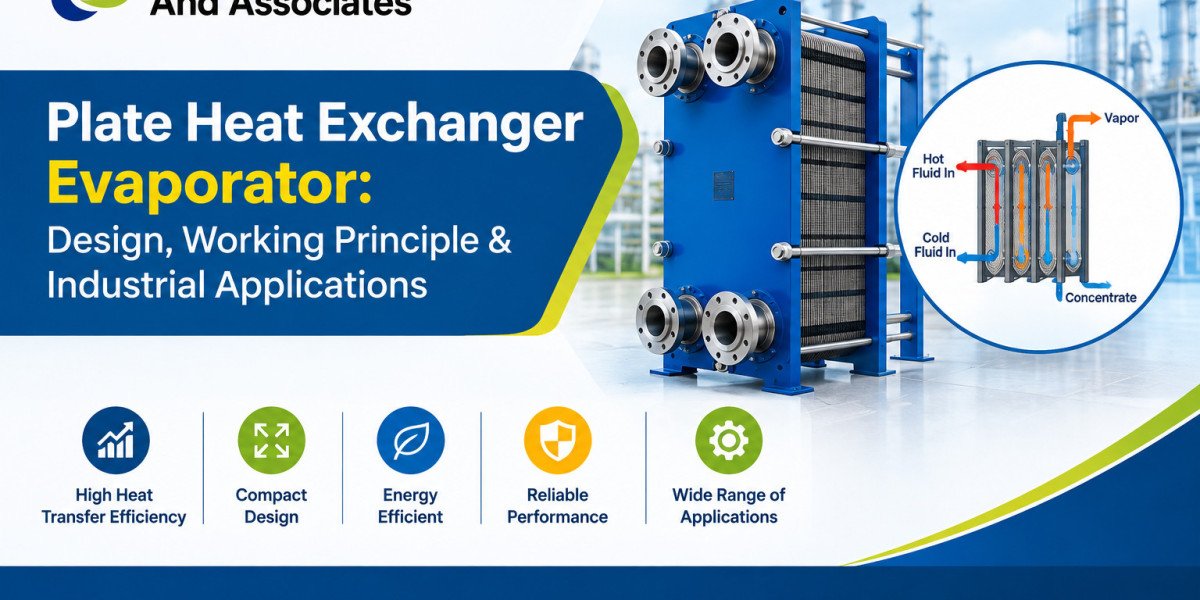

Evaporation is one of the most energy-intensive steps in industrial processing, whether the goal is concentrating a liquid, recovering a solvent, or preparing a product for further downstream treatment. Traditional evaporators — shell-and-tube units, calandria evaporators, and other older designs — have served industry for decades, but they often come with large footprints, slow heat transfer, and high energy costs. This is where the plate heat exchanger evaporator has changed the equation.
By combining the compact, high-efficiency design of plate heat exchanger technology with the specific thermal and flow requirements of evaporation, a plate heat exchanger evaporator delivers faster, more controllable, and more energy-efficient evaporation than many conventional systems. It has become a preferred choice across chemical processing, food and beverage manufacturing, dairy, pharmaceuticals, and several other industries where efficient heat transfer and evaporation are essential to daily operations.
In this article, we'll look at what a plate heat exchanger evaporator is, how it is designed, how it works, and where it is used across modern industry.
What Is a Plate Heat Exchanger Evaporator?
A plate heat exchanger evaporator is a specialized type of heat transfer equipment designed to vaporize a portion of a process liquid using heat supplied by a separate heating medium — typically steam, hot water, or a hot process fluid. Unlike a standard plate heat exchanger, which is generally used for simple liquid-to-liquid or liquid-to-gas heat transfer without a change of phase, an evaporator variant is specifically engineered to handle boiling, vapor generation, and vapor-liquid separation.
The core structure still relies on a pack of thin, corrugated metal plates arranged between a fixed frame and a movable pressure plate. However, the plate patterns, channel spacing, and port arrangements in an evaporator configuration are adapted to accommodate the volume expansion that occurs when a liquid turns into vapor. This distinction matters: a design that works well for straightforward heating or cooling duties will not necessarily perform well once boiling and two-phase flow enter the picture.
In practical terms, a plate heat exchanger evaporator allows industries to concentrate solutions, recover solvents, produce distilled or purified water, and manage other evaporation-driven processes with a level of thermal efficiency that older evaporator designs struggle to match.
Design of a Plate Heat Exchanger Evaporator
The performance of any plate heat exchanger evaporator depends heavily on how well its individual components are engineered to work together. The main design elements include:
Corrugated Heat-Transfer Plates
The plates are pressed with a corrugated or herringbone pattern that increases surface area and induces turbulence in the fluid flow. This turbulence is central to the high heat transfer efficiency plate technology is known for, since it continuously disrupts the boundary layer that would otherwise slow down heat exchange.
Plate Pack and Frame
Individual plates are stacked together to form a plate pack, which is compressed between a fixed frame plate and a movable pressure plate using tightening bolts. The number of plates in the pack is selected based on the required heat transfer capacity, allowing the same basic frame to be scaled up or down for different duties.
Gaskets
Gaskets are fitted around the edges and ports of each plate to create sealed flow channels and prevent the heating medium from mixing with the process fluid. Gasket material selection is critical in an evaporator, since it must tolerate not just temperature and pressure, but also the specific chemistry of the fluid being evaporated.
Inlet and Outlet Connections
Ports are positioned to allow the process liquid to enter, partially vaporize, and exit as a liquid-vapor mixture, while the heating medium flows through separate, sealed channels. Vapor outlet connections are typically sized larger than standard liquid connections to accommodate the increased volume of vapor.
Flow Channels
Because evaporation produces a mixture of liquid and vapor, the flow channels in an evaporator plate pack are often designed with wider gaps or modified plate patterns compared to a standard heat exchanger, reducing pressure drop and preventing flow restrictions as vapor volume increases.
Plate Materials
Plates are typically manufactured from stainless steel grades such as SS304 or SS316, or from titanium for more corrosive or chloride-heavy applications. Material selection directly affects service life, corrosion resistance, and overall reliability.
Pressure and Temperature Considerations
An evaporator must be designed to handle the operating pressure and temperature of both the process fluid and the heating medium, along with any pressure fluctuations that may occur during startup, shutdown, or load changes.
Selection Based on Process Fluid and Operating Conditions
No two evaporation duties are identical. Viscosity, fouling tendency, corrosiveness, and boiling characteristics of the process fluid all influence plate pattern, channel spacing, and material choice, which is why evaporator selection is rarely a one-size-fits-all exercise.
Working Principle of a Plate Heat Exchanger Evaporator
The working principle of a plate heat exchanger evaporator follows a straightforward but carefully engineered sequence:
Heat transfer setup: The heating medium (commonly steam or hot water) flows through alternating channels in the plate pack, while the process liquid flows through the adjacent channels, separated by the thin metal plates.
Heat transfer across the plates: Heat passes from the hot medium through the corrugated plate surface into the process liquid. Because the plates are thin and the flow is turbulent, this heat transfer happens rapidly and efficiently.
Boiling and evaporation: As the process liquid absorbs heat, it reaches its boiling point under the operating pressure of the system, and a portion of it vaporizes within the plate channels.
Two-phase flow: The resulting mixture of liquid and vapor moves through the remaining plate channels and exits through the outlet port, which is typically sized to handle the increased volumetric flow caused by vapor formation.
Vapor-liquid separation: In most industrial setups, the liquid-vapor mixture leaving the plate pack passes into a separator vessel, where the vapor is drawn off for further use, condensation, or venting, while the concentrated liquid is either collected as product or recirculated for further evaporation stages.
Fluid separation integrity: Throughout the process, the heating medium and the process fluid never come into direct contact — gaskets and plate design maintain complete separation, which protects product purity and prevents contamination.
This cycle repeats continuously as fluid flows through the system, allowing steady-state evaporation with tight control over temperature and concentration.
Key Features and Benefits
Plate heat exchanger evaporators offer several advantages over older evaporation technologies:
High heat-transfer efficiency: Corrugated plates and turbulent flow allow for significantly higher heat transfer coefficients than smooth-tube designs.
Compact footprint: A plate evaporator can often deliver the same evaporation capacity as a much larger shell-and-tube or calandria unit, saving valuable floor space.
Energy efficiency: Faster heat transfer means less energy is required to achieve the same evaporation rate, reducing overall utility consumption.
Close temperature approach: Plate designs can achieve a tighter temperature difference between the heating medium and the process fluid, improving heat recovery.
Flexible capacity: Additional plates can often be added to an existing frame to expand capacity, without needing to replace the entire unit.
Easy inspection and maintenance: The plate pack can be opened for cleaning or plate replacement without extensive dismantling of surrounding equipment.
Material and gasket flexibility: A wide range of plate and gasket materials allows the equipment to be matched to diverse process fluids.
Reliable continuous operation: With correct engineering, plate evaporators are well suited to round-the-clock industrial duty cycles.
Plate Heat Exchanger Evaporator vs. Traditional Evaporators
Factor | Plate Heat Exchanger Evaporator | Traditional Evaporator (Shell & Tube / Calandria) |
Heat transfer efficiency | High, due to turbulent flow over corrugated plates | Comparatively lower due to smoother, less turbulent flow paths |
Footprint | Compact | Larger footprint for equivalent capacity |
Maintenance | Plate pack can be opened for quick cleaning and inspection | Often requires more extensive dismantling |
Flexibility | Capacity can be adjusted by adding or removing plates | Capacity changes typically require a new or modified unit |
Approach temperature | Closer approach, better heat recovery | Wider approach temperature, less efficient recovery |
Suitability | Well suited to many industrial and process-fluid evaporation duties | Still preferred for certain very high-pressure or particulate-heavy applications |
While traditional evaporators still have a role in specific high-pressure or heavily fouling applications, plate heat exchanger evaporators are increasingly the preferred choice wherever efficiency, space, and flexibility matter.
Industrial Applications
Plate heat exchanger evaporators are used across a wide range of industries, including:
Chemical processing – concentrating chemical solutions, solvent recovery, and process fluid evaporation
Food and beverage processing – juice concentration, sugar syrup evaporation, and product concentration
Dairy – milk and whey concentration prior to further processing
Pharmaceuticals – concentration and purification steps that demand precise temperature control and hygienic design
Water and wastewater treatment – evaporative concentration of effluent streams and water recovery
HVAC and refrigeration – supporting evaporative heat transfer within cooling and refrigeration cycles
Power generation – evaporation duties within boiler feedwater and related process systems
Oil and process industries – concentration of process streams and recovery of valuable fluids
General industrial heating and evaporation – wherever a liquid stream needs to be concentrated or partially vaporized as part of a larger process
The versatility of plate technology means it can be adapted to a wide variety of process conditions, provided the plate pattern, materials, and channel design are matched correctly to the application.
Material Selection and Gasket Considerations
Selecting the right plate and gasket materials is one of the most important decisions in specifying a plate heat exchanger evaporator, since the wrong choice is a common cause of premature equipment failure.
Plate materials are generally chosen based on the corrosiveness and chemical composition of the process fluid:
SS304 – suitable for many general-purpose, less aggressive fluids
SS316 – offers improved corrosion resistance, commonly used where chlorides or mild acids are present
Titanium – specified for highly corrosive fluids, seawater, or chloride-rich streams where even SS316 may degrade over time
Gasket materials must also be matched to the operating temperature and fluid chemistry:
EPDM – performs well across a broad range of water-based and steam applications
NBR – commonly used for oil and hydrocarbon-based fluids
Viton – suited to higher-temperature applications and fluids requiring stronger chemical resistance
Working with an experienced manufacturer to align plate and gasket materials with actual process fluid data — rather than relying on generic assumptions — helps avoid costly downtime and premature replacement.
Factors to Consider When Selecting a Plate Heat Exchanger Evaporator
Choosing the right unit involves evaluating several interconnected factors:
Fluid characteristics — viscosity, composition, and boiling behavior
Flow rate — both average and peak operating conditions
Operating and design pressure — including allowances for pressure surges
Inlet and outlet temperatures — required for the specific process duty
Heat-transfer capacity — matched to the required evaporation rate
Fouling tendency — some fluids scale or foul plate surfaces more readily than others
Corrosion resistance — matched to the specific chemistry of the process fluid
Available installation space — particularly important for retrofit projects
Maintenance requirements — access needs and expected cleaning frequency
Working through these factors with an experienced engineering team helps ensure the selected unit performs reliably over its intended service life.
Maintenance and Operational Considerations
Like any heat transfer equipment, a plate heat exchanger evaporator performs best with a proactive maintenance approach:
Regular inspection of plates and gaskets to catch early signs of wear, scaling, or corrosion
Periodic cleaning, with frequency depending on the fouling tendency of the process fluid
Gasket maintenance and replacement as part of scheduled servicing to prevent leaks
Monitoring of pressure and temperature across the unit to detect performance drift or blockages early
Preventing fouling and leakage through correct operating practices and timely servicing
A consistent maintenance routine helps extend service life, protect thermal performance, and avoid unplanned downtime.
Why Choose a Customized Plate Heat Exchanger Evaporator?
Every evaporation process has its own combination of fluid properties, thermal duty, pressure, temperature, and space constraints. A generic, off-the-shelf configuration may function adequately in some cases, but it rarely delivers optimal performance across the full range of real-world operating conditions.
A customized plate heat exchanger evaporator is engineered around the specific characteristics of the process fluid, the required evaporation rate, available installation space, and long-term maintenance expectations. This process-first approach to engineering — rather than defaulting to a standard catalogue unit — helps ensure the equipment performs reliably, resists fouling and corrosion appropriately, and delivers the expected energy savings over its operating life.
Contact Us
PHE INDIA™ (Process Engineers And Associates) is an experienced manufacturer and supplier of industrial plate heat exchangers, including plate heat exchanger evaporators engineered around real process conditions rather than generic assumptions. If you're evaluating equipment for an evaporation, concentration, or heat recovery application, our team is available to discuss your specific requirements and recommend a suitable configuration.
Website: www.phemanufacturers.com
Email: sales@phe-india.in
Sales: +91 85274 55996
Alternate: +91 93505 45996
Office: E-78, Sector 63, Noida - 201301, UP
Frequently Asked Questions (FAQs)
1. What is a plate heat exchanger evaporator?
It is a heat transfer system that uses a pack of corrugated plates to heat a process liquid until part of it vaporizes, producing a concentrated liquid and a vapor stream, while keeping the heating medium and process fluid fully separated.
2. How does a plate heat exchanger evaporator work?
A heating medium such as steam or hot water flows through alternating plate channels, transferring heat to the process liquid in the adjacent channels. As the liquid absorbs heat, part of it boils and vaporizes, producing a liquid-vapor mixture that typically passes to a separator for further processing.
3. What are the main advantages of a plate heat exchanger evaporator?
Key advantages include high heat-transfer efficiency, a compact footprint, energy savings, close temperature approach, flexible capacity, and easier maintenance compared to traditional evaporator designs.
4. Where are plate heat exchanger evaporators used?
They are used across chemical processing, food and beverage manufacturing, dairy, pharmaceuticals, water and wastewater treatment, HVAC and refrigeration, power generation, and oil and process industries, among others.
5. What materials are used to manufacture plate heat exchanger evaporators?
Plates are commonly made from SS304, SS316 stainless steel, or titanium, while gaskets are typically manufactured from EPDM, NBR, or Viton, selected based on the fluid chemistry and temperature involved.
6. How do you select the right plate heat exchanger evaporator?
Selection depends on factors such as fluid characteristics, flow rate, operating pressure, inlet and outlet temperatures, required heat-transfer capacity, fouling tendency, corrosion resistance, available space, and maintenance requirements.
7. How can a plate heat exchanger evaporator be maintained?
Regular inspection, periodic cleaning based on fouling tendency, timely gasket replacement, and ongoing monitoring of pressure and temperature all help maintain performance and extend service life.
8. Can plate heat exchanger evaporators be customized?
Yes. Because evaporation duties vary significantly by fluid type, concentration target, and operating conditions, plate heat exchanger evaporators are frequently engineered to match the specific requirements of each application rather than supplied as a generic unit.
Plate heat exchanger evaporators offer a compact, energy-efficient, and highly adaptable solution for industries that depend on reliable evaporation and concentration processes. From chemical processing to food and beverage manufacturing, the combination of high heat-transfer efficiency and flexible, process-specific engineering makes this technology a practical upgrade over older evaporator designs. If your facility is evaluating a new or replacement evaporation system, working with an experienced manufacturer to match the unit to your actual process conditions is the best way to ensure long-term, reliable performance.