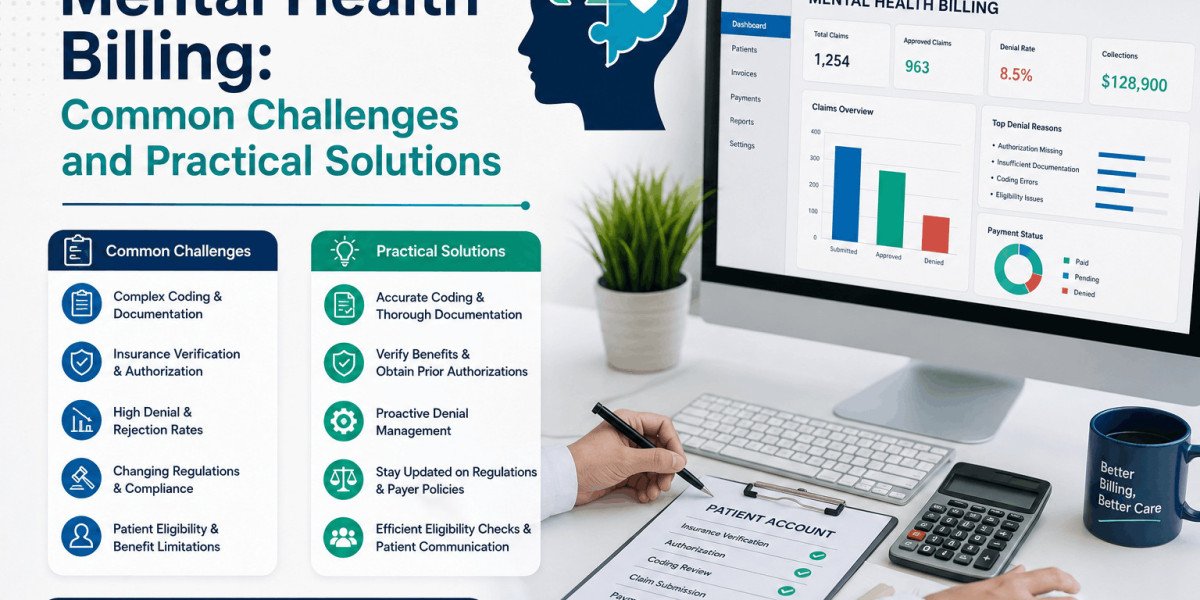

Mental health practices in California are expanding, but growth brings a billing challenge that is easy to underestimate. A provider may have a full schedule, qualified clinicians, and strong patient demand, yet still struggle to collect what has already been earned. Delayed claims, eligibility issues, coding mistakes, authorization requirements, incomplete documentation, and payer-specific rules can quietly reduce revenue month after month.
This is why choosing the right mental health billing service in California has become an important operational decision for behavioral health practices, therapists, psychologists, psychiatrists, counselors, and other mental health providers.
Billing is not simply about submitting claims. It involves connecting clinical documentation, coding, payer requirements, patient information, claims processing, payment posting, denial follow-up, and accounts receivable into one consistent process. When these pieces work together, providers can spend more time on patient care instead of repeatedly investigating unpaid claims.
Why Mental Health Billing Requires Specialized Attention
Mental health billing has many of the same foundations as general medical billing, but behavioral health services often involve additional documentation, authorization, coverage, and coding considerations.
For example, a claim can be delayed because a patient's insurance coverage changed, a required authorization was missing, a diagnosis does not support the billed service, or the claim was submitted with an incorrect modifier.
A practice that handles these problems only after a claim is rejected may spend considerable staff time correcting preventable errors.
Specialized mental health billing services approach the process differently by looking at the complete revenue cycle. This includes verifying information before services are provided, reviewing claims before submission, monitoring payer responses, and following up on unpaid balances.
The goal is simple: reduce avoidable revenue loss while keeping billing operations organized.
Common Billing Problems California Mental Health Providers Face
California's behavioral healthcare environment includes private practices, group practices, community-based organizations, and larger behavioral health facilities. Their billing requirements can vary depending on payer contracts, service types, provider credentials, and patient coverage.
Some recurring challenges include:
1. Insurance Eligibility Problems
A patient may appear insured when an appointment is scheduled, but coverage could have changed by the date of service. Benefits may also have limitations related to mental health services.
Checking eligibility and benefits before treatment helps practices identify potential patient responsibility and coverage restrictions earlier.
2. Incorrect or Incomplete Coding
Mental health claims depend heavily on accurate representation of the service provided and the clinical documentation supporting it.
Errors involving CPT codes, modifiers, diagnosis codes, units, or place of service can create unnecessary claim delays.
This is where experienced mental health medical billing teams can add value by coordinating coding review with claim preparation.
3. Prior Authorization and Payer Requirements
Certain services may require authorization or additional documentation depending on the patient's plan. Missing those requirements can result in a denial even when the treatment itself was appropriate.
The billing team needs a process for identifying these requirements rather than discovering them only after payment is rejected.
4. Denials and Unresolved A/R
A denial that sits untouched becomes a bigger financial problem over time. The longer an account remains unresolved, the more difficult it can become to recover the balance.
Effective follow-up requires identifying the denial reason, checking the payer's requirements, correcting the underlying issue, and resubmitting or appealing when appropriate.
What a Strong Mental Health Billing Process Looks Like
A reliable billing operation is built around consistency rather than simply processing a large number of claims.
A typical workflow may include:
- Patient demographic and insurance verification
- Benefits and eligibility review
- Authorization tracking
- Charge capture
- Medical coding review
- Claim creation and scrubbing
- Electronic claim submission
- Payer rejection monitoring
- Payment posting
- Denial management
- Insurance follow-up
- Patient balance management
- A/R reporting and analysis
Each step affects the next. A demographic error at registration, for instance, can eventually become a rejected claim. Likewise, an incorrect code can lead to a denial that requires additional staff time to resolve.
For this reason, mental health billing solutions should be evaluated as an entire workflow rather than as a standalone claims-submission service.
Why California Practices Consider Outsourced Billing
Hiring an internal billing team gives a practice direct control, but it also means managing salaries, training, software, turnover, productivity, and ongoing education.
Outsourcing can provide access to experienced billing professionals without requiring the practice to build every function internally.
This can be particularly useful for smaller behavioral health practices where the same employees may otherwise be responsible for scheduling, patient communication, billing, and administrative duties.
The right mental health billing company should function as an extension of the practice's administrative team, not as a disconnected claims processor.
Potential advantages include:
More consistent follow-up: Unpaid claims can be monitored according to defined work queues and aging categories.
Better visibility: Regular reports can help providers understand collections, denials, A/R aging, and payment trends.
Reduced administrative pressure: Clinical staff can spend less time investigating insurance and billing issues.
Specialized knowledge: Experienced teams are more familiar with common behavioral health billing workflows and payer requirements.
Scalability: Billing support can grow with the practice as providers, locations, and patient volume increase.
What to Look for in Mental Health Billing Companies
Not every billing company provides the same level of service. Before selecting a vendor, providers should look beyond the promise of faster collections.
A useful evaluation should cover several areas.
Experience With Behavioral Health
Ask whether the company regularly works with mental health providers and understands the services being billed. General billing experience is helpful, but specialty-specific knowledge can make a significant difference.
Denial Management
Find out how denied claims are categorized, prioritized, corrected, and followed up. A good process should identify recurring denial patterns rather than repeatedly fixing the same errors.
Reporting
Providers should have access to meaningful financial information. Useful reports may include A/R aging, denial trends, collection performance, outstanding claims, and payer-specific patterns.
Communication
Billing problems often require information from the practice. Clear communication channels and defined responsibilities help prevent claims from remaining unresolved.
Compliance Awareness
Healthcare billing involves sensitive patient information and regulatory requirements. A billing partner should have appropriate processes for privacy, security, documentation, and compliance.
The Connection Between Billing and Credentialing
Billing problems sometimes begin before the first claim is ever submitted.
If provider enrollment information is incomplete, outdated, or inconsistent with payer records, claims may encounter problems even when the clinical service and coding are correct.
That is why mental health billing and credentialing services can be valuable for practices that are adding providers or entering new payer networks.
Credentialing involves maintaining accurate provider information, payer enrollment details, licenses, certifications, and other required documentation. Keeping these records current helps reduce administrative disruption when providers join a practice or payer requirements change.
How Medical Coding Supports Mental Health Revenue
Coding is one of the most important links between clinical care and reimbursement.
A claim must accurately communicate what service was performed and why it was medically necessary based on the documentation. Poor coding can create compliance concerns as well as payment problems.
Professional medical coding services can support providers by reviewing documentation and ensuring that reported services are represented accurately.
When coding and billing teams communicate effectively, potential problems can be identified before claims reach the payer.
This is particularly important for practices that provide several types of behavioral health services, because different services may have different documentation and billing considerations.
Building a Better Revenue Cycle
A strong revenue cycle does not begin when a claim is submitted. It begins when the patient is scheduled and continues until the account is completely resolved.
For many practices, this means connecting front-end and back-end processes instead of treating them as separate departments.
For example, if eligibility verification identifies a coverage issue before an appointment, the practice has an opportunity to address it with the patient. If the same issue is discovered after a claim is denied, the practice may have fewer options and more administrative work.
This broader approach is the foundation of effective mental health RCM billing.
Providers looking for billing services for mental health providers should therefore ask how the company manages the complete revenue cycle, not simply how quickly it submits claims.
When Medical Billing and Coding Services Work Together
Separating billing and coding can create communication gaps if the two functions operate independently.
A more coordinated approach connects documentation review, coding, claim preparation, rejection management, and payment analysis.
Comprehensive medical billing and coding services can help create that connection by bringing related revenue-cycle activities into one workflow.
For a growing behavioral health practice, this may also reduce the need to coordinate several separate vendors for administrative functions.
A Practical Example
Consider a California therapy group that has expanded from three clinicians to eight.
Patient volume increases, but the practice begins noticing that outstanding claims are also increasing. Staff members are spending more time calling insurers, correcting rejected claims, and responding to patient questions about unexpected balances.
The problem may not be a lack of patients. It may be a process problem.
An analysis could reveal that eligibility verification is inconsistent, claims are not being reviewed before submission, and older A/R accounts are receiving insufficient follow-up.
Instead of simply submitting more claims, the practice can redesign its workflow:
- Verify coverage before appointments.
- Review charges and coding before submission.
- Track payer responses.
- Categorize denials by root cause.
- Prioritize aging accounts.
- Monitor recurring payer issues.
- Review financial performance regularly.
The result is a billing operation that becomes more predictable as the practice grows.
Choosing the Best Mental Health Billing Services for Your Practice
There is no single billing model that works for every provider.
A solo therapist may need basic claims and A/R support, while a multi-location behavioral health organization may require a broader infrastructure covering credentialing, coding, denial management, reporting, and revenue cycle oversight.
When comparing the best mental health billing services, consider:
- Specialty experience
- Payer knowledge
- Coding expertise
- Denial resolution capabilities
- Credentialing support
- Reporting quality
- Communication standards
- Data security practices
- Scalability
- Transparency of fees and responsibilities
The lowest-cost option is not necessarily the most economical if unresolved claims, denials, or billing errors continue to consume revenue.
How 247 Medical Billing Services Can Fit Into the Process
For practices evaluating outside support, 247 Medical Billing Services can be considered as part of a broader revenue-cycle strategy rather than simply a claims submission resource.
A comprehensive approach can bring together medical billing services, medical coding services, medical billing and coding services, revenue cycle management services, and credentialing services within the administrative side of a healthcare practice.
The value of such support ultimately comes down to process quality: accurate information, timely claims, consistent follow-up, useful reporting, and attention to outstanding revenue.
For California mental health providers, that foundation can make the difference between simply generating claims and maintaining a healthier, more predictable revenue cycle.
Frequently Asked Questions
1. What is a mental health billing service in California?
A mental health billing service supports behavioral health providers with administrative revenue-cycle activities such as eligibility verification, claim submission, payment posting, denial management, A/R follow-up, and related billing processes.
2. Why do mental health providers need specialized billing support?
Mental health practices often deal with specialty-specific coding, documentation, authorization, payer requirements, and patient responsibility issues. Specialized billing support can help organize these processes and reduce preventable billing problems.
3. What should I ask a mental health billing company before hiring it?
Ask about behavioral health experience, coding expertise, denial management, payer follow-up, credentialing, reporting, compliance procedures, communication processes, and how the company measures billing performance.
4. Can mental health billing services include credentialing?
Yes. Some providers offer combined mental health billing and credentialing services. This can help practices coordinate payer enrollment and ongoing billing operations, particularly when adding clinicians or expanding into additional networks.
5. How do medical coding services affect mental health billing?
Accurate coding helps ensure that the services reported on a claim are supported by the clinical documentation. Coding errors can contribute to denials, payment delays, and compliance concerns, making coding an important part of the overall revenue cycle.
6. Is outsourcing suitable for small mental health practices?
It can be. Smaller practices may benefit from outsourcing when internal staff lack the time or specialized expertise needed to manage eligibility, claims, denials, A/R, coding coordination, and other billing responsibilities consistently.