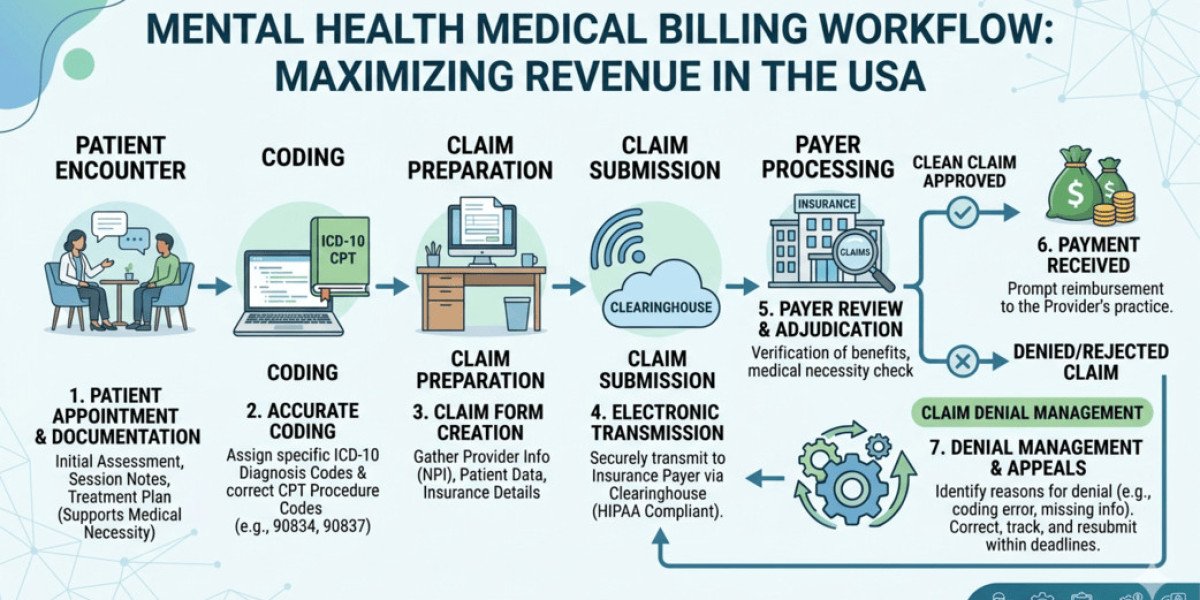

Mental health practices in Texas are navigating a billing environment that is becoming harder to manage with every passing year. Providers are expected to deliver consistent patient care while also dealing with payer requirements, changing documentation standards, authorization procedures, claim edits, credentialing delays, and growing patient responsibility. For many practices, the administrative workload can become almost as demanding as the clinical workload.
This is where choosing the top mental health billing services in Texas can make a meaningful difference. A specialized billing partner understands that behavioral and mental health claims are not simply standard medical claims with different diagnosis codes. They often involve recurring visits, telehealth, psychotherapy, psychiatric services, complex payer policies, authorization requirements, and detailed documentation.
The right mental health billing services can help providers reduce administrative pressure while creating a more organized path from patient registration to final payment.
Why Mental Health Billing Requires Specialized Expertise
Mental health medical billing has its own operational challenges. A claim can be technically correct and still face delays because of an eligibility issue, missing authorization, incorrect provider information, documentation concerns, or payer-specific requirements.
For example, consider a behavioral health practice treating a patient through weekly psychotherapy sessions. The provider may correctly document the encounter, but if eligibility has changed or the payer requires authorization for additional sessions, the claim can still encounter problems.
This is why experienced mental health billing companies focus on the complete revenue process rather than simply submitting claims.
Specialized billing teams commonly work with areas such as:
- Patient eligibility and benefits verification
- Insurance authorization and referral requirements
- Charge entry and claim submission
- CPT and ICD-10 coding review
- Claim status monitoring
- Denial identification and resolution
- Payment posting and reconciliation
- Patient balance management
- Accounts receivable follow-up
- Provider enrollment and credentialing
The goal is not merely to send more claims. It is to make sure claims move through the revenue cycle correctly.
What Should Texas Providers Look for in a Mental Health Billing Company?
Not every mental health billing company offers the same level of support. A provider should evaluate a billing partner based on how well its processes match the needs of the practice.
1. Experience With Behavioral and Mental Health Claims
Mental health practices may provide psychotherapy, psychiatric evaluations, medication management, behavioral health counseling, substance use treatment, and other specialized services.
A billing team familiar with these services is more likely to recognize common claim problems before they become recurring revenue issues.
2. Strong Eligibility and Authorization Processes
Eligibility verification should happen before services are rendered whenever possible. A patient's insurance coverage, copay, deductible, coinsurance, network status, and authorization requirements can directly affect both reimbursement and patient collections.
A strong billing process identifies these details early rather than discovering them after a claim has already been denied.
3. Accurate Coding and Documentation Review
Coding accuracy is one of the foundations of successful mental health medical billing services.
Mental health providers may work with a variety of procedure and diagnosis codes, and the correct code selection needs to reflect the actual service documented in the medical record. Billing teams should also watch for coding inconsistencies, missing information, modifier issues, and payer-specific edits.
The Connection Between Coding Accuracy and Revenue
Coding is not just an administrative task. It directly affects reimbursement.
Suppose a provider performs a service that is documented correctly but the submitted code does not accurately represent the encounter. The claim may be denied, underpaid, delayed, or require additional review.
This is why professional medical coding services can complement specialty billing operations. When coding and billing teams work together, discrepancies can be identified before claims reach the payer.
For practices that need broader support, combining medical billing and coding services can create a more coordinated workflow. Instead of treating coding and billing as separate activities, the practice can establish a consistent process from documentation through reimbursement.
Denial Management Is More Than Resubmitting Claims
One of the biggest mistakes a practice can make is treating every denial as an isolated event.
A denial should answer an important question: Why did the payer reject or reduce the claim, and is the same problem affecting other claims?
For example, if a mental health practice repeatedly receives denials because of authorization issues, simply resubmitting individual claims will not solve the underlying problem.
A better approach is to identify the pattern, determine where the workflow failed, correct the process, and monitor future claims.
Effective denial management may involve:
- Categorizing denials by root cause
- Identifying payer-specific trends
- Reviewing authorization failures
- Correcting coding errors
- Checking patient eligibility
- Appealing appropriate claims
- Tracking appeal outcomes
- Monitoring recurring denial patterns
This approach turns denial management into a revenue improvement process rather than a repetitive administrative exercise.
How Mental Health RCM Billing Supports Practice Growth
Mental health RCM billing covers much more than claim submission. It looks at the complete financial lifecycle of a patient account.
The process can begin with scheduling and insurance verification and continue through charge capture, coding, claim submission, payment posting, denial management, and patient collections.
A well-managed revenue cycle can help practices gain better visibility into questions such as:
- How many claims are currently pending?
- Which payers generate the most denials?
- How much money is sitting in aging accounts receivable?
- Which claims require follow-up?
- Are payments being posted accurately?
- Are patient balances being communicated clearly?
- Where is revenue being lost?
These insights help practice owners make operational decisions based on actual revenue-cycle performance instead of assumptions.
Mental Health Billing and Credentialing Should Work Together
For a growing practice, billing problems can begin before the first claim is submitted.
Provider enrollment and credentialing directly influence whether providers can participate with insurance networks and receive reimbursement correctly. Incorrect provider information, expired enrollment, or incomplete payer enrollment can create significant payment delays.
This makes mental health billing and credentialing services particularly valuable for practices adding providers, expanding locations, or entering new payer networks.
Professional credentialing services may support activities such as:
- Provider enrollment
- Payer applications
- Recredentialing
- CAQH profile maintenance
- NPI-related information
- License and certification tracking
- Demographic updates
- Payer participation monitoring
Keeping provider information accurate helps reduce avoidable administrative complications later in the revenue cycle.
Telehealth Adds Another Layer of Complexity
Telehealth has become an important part of mental health care, particularly for patients who may have difficulty traveling to an office.
However, telehealth billing can introduce additional considerations. Payer policies may differ regarding eligible services, provider locations, patient locations, modifiers, documentation, and reimbursement rules.
A practice should therefore avoid assuming that an approach that works for one payer will automatically work for another.
A knowledgeable billing team can help monitor payer requirements and identify potential billing inconsistencies before they become widespread denial problems.
What Makes the Best Mental Health Billing Services Different?
The best mental health billing services are not necessarily the companies that promise the highest collection percentage or the fastest claim submission.
A better evaluation focuses on the quality of the entire process.
Look for a provider that offers:
Transparent Reporting
Providers should be able to see meaningful information about collections, denials, accounts receivable, claim status, and other revenue-cycle indicators.
Dedicated Follow-Up
Unpaid claims should not simply remain in an aging report. They require timely investigation and payer follow-up.
Specialty Knowledge
A billing team should understand behavioral health workflows rather than applying a generic medical billing process to every specialty.
Scalable Processes
The billing operation should continue to work effectively as the practice adds providers, patients, locations, or services.
Clear Communication
Providers should know what is happening with their claims and why specific revenue problems are occurring.
Choosing Billing Services for Mental Health Providers in Texas
Texas is a large and diverse healthcare market. A mental health practice in Houston may have different operational circumstances from a smaller behavioral health clinic serving patients in a rural community.
When comparing billing services for mental health providers, practices should consider their own patient volume, payer mix, specialty services, provider structure, and growth plans.
Before selecting a billing partner, ask:
- How much experience do you have with mental health and behavioral health billing?
- How do you handle recurring claim denials?
- What is your process for eligibility verification?
- How do you monitor authorization requirements?
- Do you provide coding support?
- How frequently are unpaid claims followed up?
- Can you support provider credentialing?
- What revenue-cycle reports will the practice receive?
- How are payer-specific issues identified?
- How do you protect patient and practice information?
The answers can reveal whether a company is genuinely equipped to support the practice or simply offering basic claim submission.
A More Complete Approach to Medical Billing
For practices that want broader administrative support, medical billing services can provide assistance across the revenue cycle rather than focusing on one isolated task.
Similarly, medical coding services can support accurate coding workflows, while medical billing and coding services bring the two functions together. When these processes are coordinated with revenue cycle management services, practices can gain a clearer view of how clinical activity translates into collected revenue.
Adding credentialing services can further support practices that are hiring providers or expanding insurance participation.
This integrated approach can be particularly useful for growing mental health organizations that do not want their clinical staff spending large portions of their day handling billing administration.
Why Outsourcing Can Be a Practical Option
Hiring and maintaining an internal billing department requires staff, training, software, oversight, quality control, and continuous education. For smaller practices, maintaining all of these resources internally may not always be practical.
Outsourcing can give a practice access to specialized billing personnel without requiring the provider to build an entire revenue-cycle department from the ground up.
However, outsourcing should not mean losing visibility. The provider should remain informed about financial performance, denial trends, outstanding claims, and operational issues.
That is where mental health billing solutions can provide value: they can combine specialized expertise with structured reporting and ongoing revenue-cycle management.
The Role of 247 Medical Billing Services
For practices evaluating specialized support, 247 Medical Billing Services takes a broader approach by connecting billing, coding, revenue-cycle operations, and credentialing into a coordinated workflow.
For a mental health practice, the value of such an approach is not simply having someone submit claims. It is having a process designed to identify issues earlier, follow up on unpaid revenue, address denial patterns, and maintain cleaner administrative workflows.
The right partner should ultimately function as an extension of the practice's administrative team while allowing clinicians to remain focused on patient care.
Final Thoughts
Finding the top mental health billing services in Texas should not come down to choosing the company with the biggest marketing claims. Mental health providers need a billing partner that understands specialty-specific workflows, payer requirements, coding accuracy, authorization challenges, credentialing, and the full revenue cycle.
A strong billing operation can help identify revenue leakage, reduce avoidable administrative problems, improve claim follow-up, and give practice leaders better financial visibility.
Whether a practice needs focused medical billing services, specialized medical coding services, combined medical billing and coding services, comprehensive revenue cycle management services, or reliable credentialing services, the most important factor is how well those services work together.
For Texas mental health providers, a specialized and well-managed billing process can create a stronger financial foundation while allowing clinical teams to spend more time doing what matters most: delivering quality care to their patients.
Frequently Asked Questions
1. What are mental health billing services?
Mental health billing services handle financial and administrative activities related to behavioral and mental health care. These may include eligibility verification, coding, claim submission, denial management, payment posting, accounts receivable follow-up, and patient billing.
2. Why should a mental health practice use specialized billing services?
Mental health claims can involve specialty-specific coding, authorization requirements, documentation considerations, recurring visits, and payer rules. Specialized billing teams are familiar with these challenges and can build workflows around them.
3. Can mental health billing companies help with denied claims?
Yes. A qualified billing company can investigate denial reasons, correct appropriate claims, submit appeals when necessary, and analyze recurring denial patterns to identify underlying workflow problems.
4. What are mental health billing and credentialing services?
These services combine revenue-cycle support with provider enrollment and credentialing activities. They can be useful for practices adding providers, joining insurance networks, or maintaining existing payer participation.
5. How can mental health RCM billing improve a practice?
Mental health RCM billing manages the financial process from patient registration and eligibility through claims, payments, denials, and accounts receivable. A structured RCM process can improve visibility into unpaid claims and recurring revenue problems.
6. What should I check before choosing a mental health billing company in Texas?
Evaluate its experience with mental health billing, coding capabilities, denial management process, payer follow-up, credentialing support, reporting, communication practices, and ability to scale with your practice.