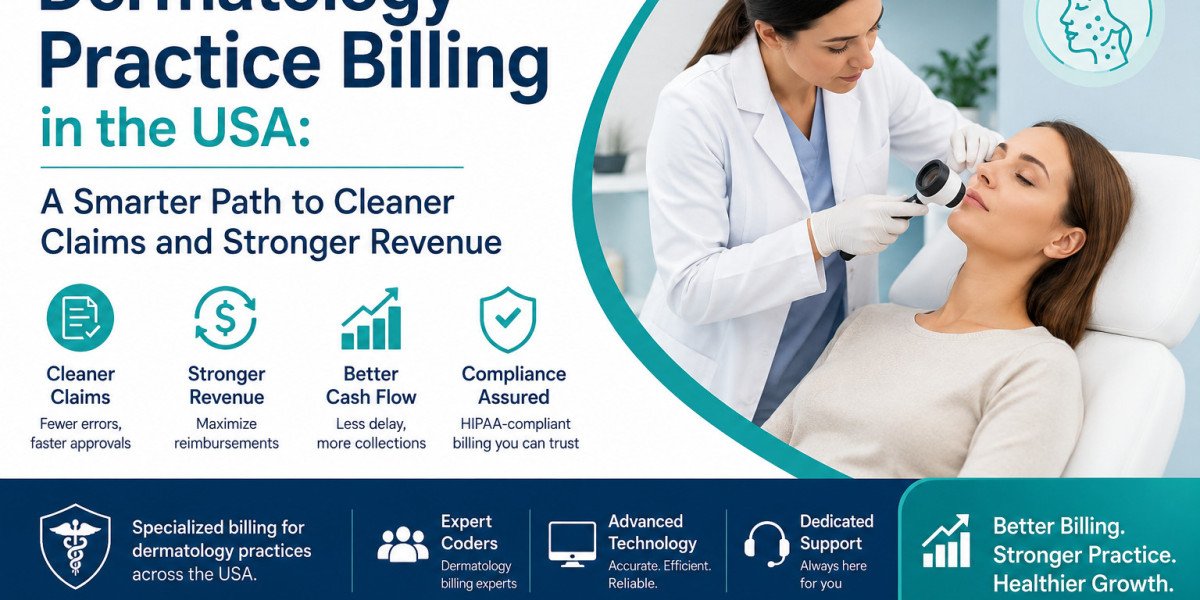

Dermatology practices handle far more than routine office visits. A single day can involve biopsies, lesion removals, pathology coordination, cosmetic procedures, follow-up visits, chronic skin conditions, and surgical services. Each type of care can carry different documentation, coding, coverage, and reimbursement requirements. When even one part of that process is overlooked, a practice can lose revenue without immediately realizing where the problem occurred.
This is why choosing the right dermatology billing services company has become an important operational decision for dermatology practices across the USA. Effective billing is not simply about submitting claims. It involves connecting clinical documentation, medical coding, payer requirements, claim submission, payment posting, denial management, and patient balances into one coordinated process.
For dermatologists, that coordination can make the difference between a predictable revenue cycle and a growing backlog of unpaid claims.
Why Dermatology Billing Requires Specialized Knowledge
Dermatology billing has its own set of challenges. Practices may provide medically necessary treatment alongside elective or cosmetic services, making accurate classification especially important.
For example, a dermatologist may treat a patient for acne during one visit, perform a biopsy during another, and later provide treatment for a diagnosed skin condition. Each encounter requires appropriate documentation and coding based on the actual service performed.
A billing team unfamiliar with dermatology may overlook details such as:
- Procedure-specific documentation requirements
- Correct CPT and HCPCS code selection
- ICD-10-CM diagnosis specificity
- Global surgical periods
- Modifier requirements
- Pathology-related billing considerations
- Medical necessity requirements
- Payer-specific reimbursement policies
- Patient responsibility for non-covered services
- Prior authorization requirements
A specialized billing partner understands that successful reimbursement starts well before a claim reaches the payer.
What a Dermatology Billing Services Company Actually Handles
A professional billing company can support multiple stages of the revenue cycle instead of focusing only on claim submission.
Patient Registration and Insurance Verification
Errors often begin at registration. Incorrect demographic information, outdated insurance details, or an inactive policy can result in claim rejections before the payer evaluates the medical service.
Insurance verification helps confirm:
- Patient eligibility
- Coverage dates
- Benefits
- Copayment requirements
- Deductibles
- Coinsurance
- Referral requirements
- Prior authorization requirements
For dermatology practices that perform higher-value procedures, verifying coverage before treatment can also reduce unexpected patient balances.
Charge Entry and Medical Coding
Accurate charge capture is another critical part of dermatology revenue management. Services must be translated from clinical documentation into appropriate billing codes.
This is where medical coding services become particularly valuable. Coders must understand the relationship between the documented diagnosis, procedure, anatomical site, and medical necessity.
A coding error can have several consequences. A claim may be denied, underpaid, delayed, or incorrectly billed to the patient. In some circumstances, repeated coding problems can also attract unwanted payer scrutiny.
The objective should not be to select the highest-paying code. It should be to select the code that accurately represents the documented service.
The Connection Between Coding Accuracy and Clean Claims
A strong billing operation treats coding and claims management as connected processes.
Consider a dermatology practice performing a biopsy. The documentation needs to support the service, the diagnosis needs to accurately describe the patient's condition, and the claim needs to contain the appropriate procedure and diagnosis information.
If these elements do not align, the claim may require correction before payment.
This is why integrated medical billing and coding services can be more effective than treating coding and billing as completely separate activities. When coders and billers communicate regularly, recurring errors can be identified and corrected at their source.
Denial Management: Where Lost Revenue Often Hides
A denied claim is not necessarily lost revenue, but an unmanaged denial can become lost revenue.
Dermatology practices may encounter denials related to:
- Medical necessity
- Invalid or missing modifiers
- Incorrect diagnosis codes
- Authorization issues
- Coverage limitations
- Timely filing
- Duplicate claims
- Incorrect patient information
- Bundling and global period rules
- Coordination of benefits
A good denial management process does more than resubmit claims. It identifies why denials are occurring.
For instance, if a practice repeatedly receives medical-necessity denials for a particular procedure, the billing team should investigate whether the issue is related to diagnosis selection, documentation, payer policy, or authorization.
That distinction matters because repeatedly correcting individual claims without fixing the underlying workflow allows the same problem to continue.
Why Revenue Cycle Management Matters to Dermatology Practices
Revenue cycle performance extends beyond billing. It includes every financial activity from the patient's first appointment through final payment.
Professional revenue cycle management services can help practices monitor areas such as:
- Claim acceptance rates
- Denial rates
- Days in accounts receivable
- Aging accounts
- Payment turnaround
- Patient collections
- Underpayments
- Outstanding insurance balances
- Unresolved claims
Imagine a dermatology practice with a large accounts receivable balance. The problem may not be a lack of patients or insufficient claim volume. It could be that claims are being submitted correctly but are not being followed up within an appropriate timeframe.
Another practice may have strong collections but consistently high denial rates. That indicates a different operational problem.
The value of RCM is its ability to look at the entire financial picture rather than one isolated billing task.
Why Outsourcing Can Make Sense for Growing Dermatology Practices
Hiring and maintaining an internal billing department requires staff, training, software, supervision, quality control, and ongoing education. Payer policies and coding requirements can also change, creating a continuing training burden.
Outsourcing can provide access to specialized billing professionals without requiring a practice to build every function internally.
A dermatology practice may choose outsourcing when it is experiencing:
- Increasing claim volume
- Persistent billing backlogs
- High denial rates
- Slow accounts receivable follow-up
- Difficulty recruiting experienced billers
- Coding inconsistencies
- Poor visibility into RCM performance
- Administrative overload among clinical staff
The right partner should function as an extension of the practice rather than simply acting as a claim submission vendor.
Lessons From Other Specialized Healthcare Billing Areas
Although dermatology has its own billing requirements, some revenue cycle challenges are common across medical specialties.
For example, providers researching billing for mental health therapists often encounter issues involving authorization, eligibility, payer-specific rules, documentation, and patient responsibility. Similarly, medical billing for mental health services requires careful attention to behavioral health coding and payer policies.
These examples demonstrate an important principle: healthcare billing is rarely one-size-fits-all.
Practices considering outsourcing mental health billing or other specialty billing services often look for teams that understand the specific workflows of their specialty. The same principle applies to dermatology.
A mental health billing specialist, for example, may understand behavioral health requirements that a general medical biller does not. In the same way, dermatology practices benefit from professionals who understand dermatology procedures, coding patterns, documentation requirements, and payer behavior.
Specialty Knowledge Is More Important Than Generic Billing Experience
A billing company may have years of experience in healthcare but still lack deep expertise in dermatology.
When evaluating a potential partner, practices should ask questions such as:
- How familiar is the team with dermatology procedures?
- Does the company provide coding audits?
- How are denied claims categorized and analyzed?
- How frequently are aging accounts reviewed?
- How are payer-specific changes communicated?
- What reports will practice leadership receive?
- How are underpayments identified?
- What quality-control process is used before claims are submitted?
These questions can reveal whether a company understands revenue cycle management or simply processes transactions.
Credentialing Is Another Important Piece of the Revenue Cycle
Revenue problems can begin before a provider ever submits a claim.
If a provider is not properly enrolled or credentialed with a payer, claims may be rejected or delayed. Provider information must also remain accurate when physicians change locations, add specialties, join groups, or enroll with additional insurance networks.
This is where credentialing services can support the broader revenue cycle. Credentialing and billing should not be viewed as unrelated administrative activities. Provider enrollment directly affects whether a practice can receive reimbursement from specific payers.
Keeping enrollment information current can help reduce avoidable administrative interruptions.
What a Strong Dermatology Billing Workflow Looks Like
A reliable dermatology revenue cycle typically follows a connected sequence:
Patient Registration → Eligibility Verification → Authorization → Documentation → Coding → Charge Capture → Claim Scrubbing → Claim Submission → Payment Posting → Denial Management → A/R Follow-Up → Patient Collections
The strength of this process depends on how well each stage communicates with the next.
For example, if authorization information is not transferred correctly to billing, the claim may be denied. If documentation does not support the selected code, a clean claim may still become an audit or medical-necessity issue.
The goal is therefore not merely faster billing. It is fewer preventable errors throughout the entire cycle.
Technology Helps, But Expertise Still Matters
Modern billing platforms can automate eligibility checks, claim scrubbing, payment posting, reporting, and work queues. Automation can reduce repetitive administrative work, but technology does not eliminate the need for experienced professionals.
A system may identify that a claim contains an issue. A knowledgeable billing specialist still needs to understand why the problem occurred and determine the appropriate resolution.
The best approach combines automation with human oversight.
This is especially important when dealing with unusual procedures, payer-specific rules, complex denials, or documentation questions.
Choosing the Right Billing Partner
A dermatology practice should evaluate a billing company based on more than pricing.
Important considerations include:
- Dermatology-specific experience
- Coding expertise
- Transparent reporting
- Denial management capabilities
- Insurance follow-up processes
- Credentialing support
- Data security practices
- Communication standards
- Scalability
- Quality assurance
A low-cost service that produces recurring coding errors or leaves old claims untouched can ultimately cost more than a specialized partner with a stronger process.
How 247 Medical Billing Services Fits Into the Conversation
For practices evaluating external support, 247 Medical Billing Services represents the type of partner practices can consider when looking for broader revenue cycle support.
The important consideration is not simply whether a company can submit claims. A capable partner should be able to support the financial workflow surrounding those claims.
That may include medical billing services for claim processing and follow-up, medical coding services for accurate code assignment, integrated medical billing and coding services for coordinated workflows, and revenue cycle management services for monitoring the financial performance of the practice.
Support can also extend to credentialing services, helping practices maintain appropriate payer enrollment and reduce administrative barriers to reimbursement.
For dermatology providers, the practical benefit comes from having these functions work together rather than operating as disconnected tasks.
Final Thoughts
A dermatology practice can provide excellent patient care and still experience financial stress when its billing process is inefficient. Unresolved claims, coding mistakes, eligibility issues, authorization problems, and aging accounts can quietly reduce revenue over time.
Working with a specialized dermatology billing services company can give practices access to structured billing workflows, coding expertise, denial management, payer follow-up, and broader revenue cycle oversight.
The same lesson applies across healthcare specialties. Whether a provider is researching outsourced billing for mental health, a mental health billing solution, Ohio Medicaid mental health billing, or specialty-focused dermatology revenue management, the central objective remains the same: create a billing process that accurately connects patient care with timely reimbursement.
For dermatology practices in the USA, the strongest billing strategy is one that combines specialty knowledge, accurate documentation, disciplined follow-up, payer awareness, technology, and consistent revenue cycle monitoring.
Frequently Asked Questions
1. What does a dermatology billing services company do?
A dermatology billing services company manages financial processes such as insurance verification, charge entry, coding support, claim submission, payment posting, denial management, accounts receivable follow-up, and patient billing. Depending on the provider, services may also include credentialing and broader RCM support.
2. Why is specialized dermatology billing important?
Dermatology includes a wide range of office-based, procedural, surgical, and diagnostic services. Specialized knowledge helps billing teams understand procedure-specific coding, documentation, medical necessity, modifiers, payer requirements, and reimbursement rules.
3. Can outsourcing dermatology billing reduce claim denials?
Outsourcing cannot guarantee that every claim will be paid, but an experienced billing team can reduce preventable errors through eligibility verification, coding review, claim quality checks, authorization tracking, and systematic denial analysis.
4. What should dermatologists look for in a billing company?
Practices should evaluate specialty experience, coding expertise, denial management, A/R follow-up, reporting, credentialing capabilities, communication processes, security practices, and the company's ability to scale as the practice grows.
5. How are medical coding services connected to billing?
Coding translates clinical documentation into standardized billing codes used on claims. Accurate coding supports medical necessity, appropriate reimbursement, and cleaner claims, making it a fundamental part of the billing process.
6. Is revenue cycle management different from medical billing?
Yes. Medical billing is one component of the revenue cycle. Revenue cycle management covers a broader financial workflow, including registration, eligibility, authorization, coding, billing, payment posting, denials, accounts receivable, and patient collections.