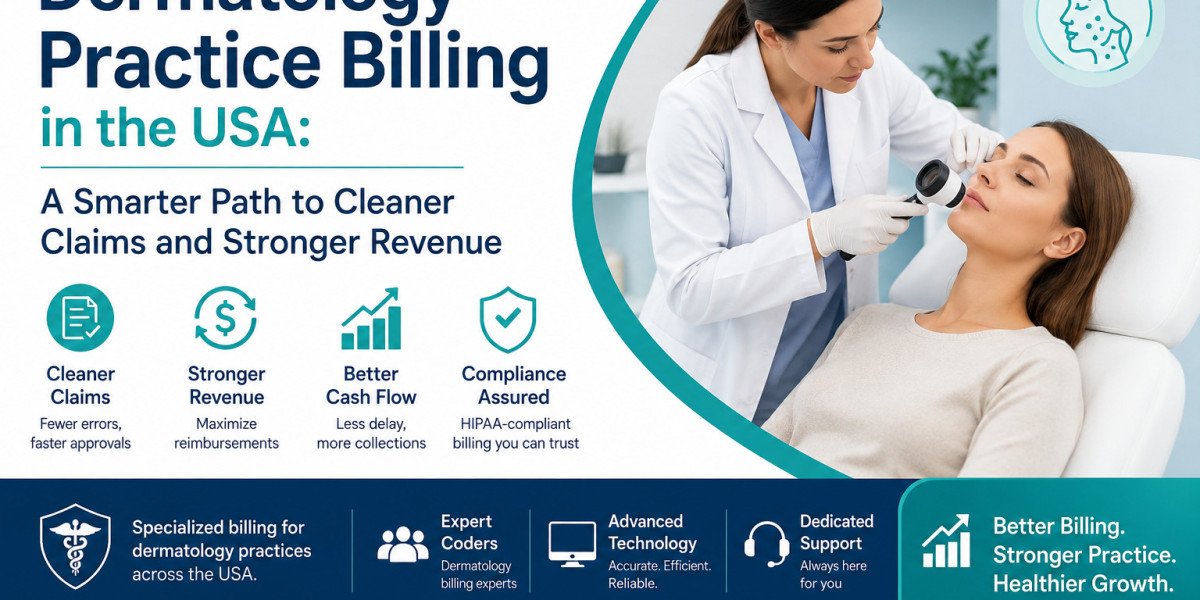

Dermatology practices deal with a billing environment that is more complicated than it may appear. A single visit can involve evaluation and management services, biopsies, lesion removals, pathology, wound care, injections, cosmetic procedures, and other treatments, each with its own documentation and coding requirements. When claims are submitted with incorrect codes, missing modifiers, incomplete documentation, or payer-specific errors, reimbursement can quickly become delayed.
This is one reason many practices are considering dermatology billing services outsourcing. Instead of managing every billing task internally, dermatologists can work with experienced billing professionals who understand specialty-specific coding, payer requirements, claim submission, denial follow-up, and accounts receivable.
The goal is not simply to send billing work to an outside company. Effective outsourcing should create a more organized revenue cycle while allowing physicians and staff to focus more attention on patient care.
Why Dermatology Billing Requires Specialized Knowledge
Dermatology billing has several moving parts that require more than basic knowledge of medical claims. The services provided during a dermatology encounter must be accurately translated into CPT, HCPCS, and ICD-10 codes while following payer policies and documentation requirements.
For example, a practice may perform a biopsy during an office visit. The claim may require appropriate procedure coding, diagnosis coding, modifiers, units, and supporting documentation. If any of these elements are inconsistent with the medical record, the claim could be rejected or denied.
The same challenge applies to procedures such as:
- Destruction of benign or premalignant lesions
- Shave and punch biopsies
- Excision procedures
- Mohs-related services
- Cryotherapy
- Skin cancer treatment
- Intralesional injections
- Repair procedures
- Phototherapy
- Wound care
- Evaluation and management services
Because of these complexities, dermatology billing providers need a strong understanding of both clinical documentation and payer billing rules.
What Does Outsourcing Dermatology Billing Involve?
Outsourcing dermatology billing means transferring some or all revenue-cycle responsibilities to an external billing team. The scope can vary depending on the practice.
Some dermatology groups outsource only claims and payment posting, while others choose a complete billing solution covering the entire revenue cycle.
Typical outsourced responsibilities may include:
- Patient demographic and insurance verification
- Charge entry
- Medical coding review
- Claim creation and submission
- Claim status monitoring
- Rejection correction
- Denial analysis
- Payment posting
- Patient balance management
- Accounts receivable follow-up
- Insurance appeals
- Reporting and revenue analysis
A well-designed outsourcing arrangement should integrate these activities rather than treating them as isolated administrative tasks.
How Outsourcing Dermatology Billing Services Can Improve Revenue Cycle Performance
The financial impact of billing problems is often hidden. A practice may continue seeing patients and generating charges while unpaid claims quietly accumulate in accounts receivable.
Outsourcing dermatology billing services can help identify these problems earlier.
1. More Consistent Charge Capture
Every billable service needs to be captured correctly. Missed charges can create revenue leakage before a claim is even submitted.
An experienced billing team can compare clinical documentation, charge information, and coding data to identify inconsistencies and reduce preventable losses.
2. Better Coding Accuracy
Dermatology coding can become complicated when multiple procedures are performed during one encounter. Incorrect code selection or modifier usage can result in denials or underpayment.
Specialized medical coding services can help practices review documentation and ensure that reported services are appropriately supported.
3. Faster Claim Submission
Delays between the date of service and claim submission can negatively affect cash flow. Outsourced teams can establish structured workflows for reviewing charges and submitting clean claims promptly.
The objective is simple: reduce the time between providing a service and receiving appropriate reimbursement.
4. Stronger Denial Management
Not every denied claim is caused by the same problem. One denial may involve eligibility, another may involve coding, while another may be related to authorization or medical necessity.
Instead of repeatedly correcting individual claims without identifying the underlying issue, an experienced team can categorize denials and identify recurring patterns.
This transforms denial management from a reactive process into a performance-improvement strategy.
The Importance of Dermatology Coding Expertise
One of the biggest mistakes a practice can make is treating billing and coding as completely separate functions.
Coding determines how clinical services are represented on a claim. Billing then uses that information to submit the claim and pursue reimbursement. Errors introduced during coding can therefore affect the entire revenue cycle.
This is why practices considering dermatology billing and coding services should evaluate whether the outsourcing partner has experience with dermatology-specific procedures and payer requirements.
A qualified team should understand the relationship between:
- Clinical documentation
- ICD-10 diagnosis selection
- CPT procedure coding
- HCPCS codes when applicable
- Modifiers
- NCCI edits
- Medical necessity
- Payer-specific policies
- Authorization requirements
- Claim edits
The objective is not to code for maximum reimbursement regardless of documentation. Proper coding should accurately reflect the services actually performed and documented.
When Should a Practice Consider Outsourcing Your Dermatology Billing?
There is no single point at which every practice should outsource. However, certain operational problems are strong indicators that the current billing process needs improvement.
A dermatology practice may benefit from outsourcing your dermatology billing when:
- Claims are frequently rejected or denied.
- A/R continues to increase.
- Staff spend excessive time calling insurance companies.
- Providers frequently have to resolve billing questions.
- Coding errors are discovered after claims are submitted.
- Payment posting is delayed.
- Aging accounts receive inconsistent follow-up.
- Billing staff turnover disrupts workflow.
- The practice lacks specialty-specific coding expertise.
- Management does not have clear revenue-cycle reports.
In these situations, outsourcing can provide additional expertise without requiring the practice to build a larger internal billing department.
What to Look for in a Medical Billing Company With Dermatology Expertise
Choosing a vendor based only on price can create problems later. A low-cost billing service may not provide the specialty knowledge or follow-up required for complex dermatology claims.
When evaluating a medical billing company with dermatology expertise, consider several factors.
Specialty Experience
Ask whether the company regularly works with dermatology practices. General billing experience is useful, but dermatology-specific knowledge can make a significant difference when handling procedure-heavy claims.
Coding Capabilities
Determine whether the company has qualified coding professionals who understand dermatology procedures and documentation requirements.
Denial Workflow
Ask how denied and rejected claims are categorized, corrected, resubmitted, and tracked. A strong process should focus on preventing recurring denials rather than simply working individual accounts.
A/R Management
Review how the company handles aging insurance balances. Effective A/R management requires systematic prioritization based on payer, claim value, age, and denial status.
Reporting
You should be able to understand how the billing operation is performing. Useful reports may include charges, payments, adjustments, denial rates, A/R aging, collection performance, and claim status.
Dermatology Specialists Billing: Why Workflow Matters
Dermatology specialists often operate in fast-paced environments. Multiple providers may see patients throughout the day while procedures are performed across different locations or departments.
Without a standardized workflow, small administrative gaps can become expensive.
For example, suppose a procedure is performed but the charge is not entered until several days later. The delay may seem insignificant on one claim. Across hundreds of monthly encounters, however, those delays can affect overall cash flow.
A structured dermatology specialists billing process connects front-office information, clinical documentation, coding, billing, payment posting, and A/R follow-up.
That continuity is one of the major advantages of professional outsourcing.
Outsourcing Is More Than Sending Claims
Some practices assume that dermatology outsource billing simply means hiring someone to submit insurance claims. In reality, effective outsourcing should cover much more.
Modern billing operations can include eligibility verification, authorization checks, coding validation, claim scrubbing, electronic submission, rejection management, payment reconciliation, denial appeals, and patient billing support.
This broader approach is especially useful for practices looking to improve revenue cycle management services rather than simply reduce administrative workload.
A successful revenue cycle should answer important questions:
- How much was billed?
- How much was collected?
- Which claims remain unpaid?
- Why are claims being denied?
- Which payers create the most delays?
- How old is the outstanding A/R?
- Where is revenue being lost?
- Which workflow problems are recurring?
These insights allow practice leaders to make informed operational decisions.
Credentialing and Provider Enrollment Also Matter
Billing performance can suffer before a provider submits a single claim if enrollment information is incomplete or outdated.
Provider credentialing involves payer enrollment, documentation, revalidation, demographic updates, and maintaining participation requirements. When providers change locations, specialties, tax information, or group affiliations, payer records may also need to be updated.
For this reason, some practices combine billing support with credentialing services. Keeping enrollment information accurate can reduce avoidable claim problems associated with provider participation and payer records.
Credentialing should not be viewed as a one-time administrative task. It requires ongoing attention as payer requirements and provider circumstances change.
Choosing Between In-House Billing and Outsourcing
Hiring a dermatology billing service is not automatically the right choice for every practice. Some large organizations have established internal revenue-cycle departments with experienced coders, billers, auditors, and denial specialists.
The decision should be based on performance rather than assumptions.
Compare:
- Internal staffing costs
- Training requirements
- Technology expenses
- Coding expertise
- Productivity
- Denial rates
- A/R aging
- Claim turnaround time
- Management workload
- Scalability
If an internal department performs well and has the resources to maintain that performance, there may be little reason to change. However, if staffing limitations or billing inefficiencies are affecting collections, outsourcing can provide additional capacity and expertise.
A Practical Example of Outsourcing Impact
Consider a growing dermatology practice that has added two providers. Patient volume increases, but the existing billing staff remains unchanged.
At first, the practice sees higher monthly charges. Within several months, however, unworked claims begin accumulating. Payment posting falls behind, older A/R receives less attention, and providers notice more patient billing questions.
The problem is not a lack of patients. It is a capacity problem within the revenue cycle.
By introducing specialized medical billing services, the practice can create dedicated workflows for coding, claim submission, payment posting, denial follow-up, and A/R management.
The result should not simply be fewer tasks for office staff. The larger objective is to create a revenue cycle capable of supporting future growth.
How to Evaluate an Outsourcing Partner
Before signing an agreement, dermatology practices should ask practical questions.
Does the company have dermatology-specific experience? How are coding errors reviewed? What happens when a claim is denied? How often is A/R followed up? What reports will management receive? How are payer changes monitored? What technology is used for claim tracking and communication?
It is also worth asking about security, staff training, quality control, communication procedures, and escalation processes.
The best outsourcing relationship should feel like an extension of the practice's revenue-cycle team rather than a disconnected third-party operation.
The Role of Integrated Medical Billing and Coding Services
When billing and coding teams work from disconnected processes, communication gaps can create unnecessary errors.
Integrated medical billing and coding services can connect documentation review, coding, claim preparation, denial analysis, and reimbursement follow-up.
This makes it easier to identify where a problem originated. If a payer repeatedly denies a particular procedure, the billing team can work with coding professionals to determine whether the issue involves documentation, code selection, modifier usage, authorization, or payer policy.
That feedback loop can help improve future claims instead of repeatedly fixing the same problem.
Final Thoughts
Dermatology practices operate in a specialty where accurate documentation, procedure coding, payer compliance, and timely claims processing all influence financial performance. Dermatology billing services outsourcing can provide practices with specialized support while reducing the administrative pressure placed on internal teams.
The right outsourcing strategy should extend beyond basic claim submission. It should connect medical billing services, medical coding services, medical billing and coding services, revenue cycle management services, and credentialing services into a coordinated process.
For practices exploring this approach, 247 Medical Billing Services can be considered as part of the evaluation process, particularly when the objective is to build a more organized and accountable revenue cycle rather than simply transfer administrative tasks.
Ultimately, the strongest outsourcing relationship is one that improves visibility, reduces preventable billing problems, supports accurate reimbursement, and gives dermatology professionals more time to concentrate on patient care.
Frequently Asked Questions
1. What is dermatology billing services outsourcing?
Dermatology billing services outsourcing involves hiring an external billing team to manage selected or complete revenue-cycle activities for a dermatology practice. Services may include coding, charge entry, claim submission, denial management, payment posting, A/R follow-up, and reporting.
2. Why is dermatology billing different from general medical billing?
Dermatology includes many procedure-based services, including biopsies, lesion destruction, excisions, injections, wound care, and skin cancer treatments. Accurate reimbursement often depends on detailed knowledge of procedure codes, diagnosis codes, modifiers, documentation, and payer policies.
3. When should a dermatology practice consider outsourcing billing?
A practice may consider outsourcing when claim denials are increasing, A/R is aging, internal staff are overloaded, coding expertise is limited, or providers are spending too much time dealing with billing-related issues.
4. Can outsourced dermatology billing include coding?
Yes. Depending on the agreement, an outsourcing provider can offer integrated dermatology billing and coding support. Coding professionals can review documentation and assign appropriate codes before claims are submitted.
5. How can outsourced billing help reduce denials?
Specialized billing teams can identify denial patterns, correct claim errors, monitor payer responses, submit corrected claims, and manage appeals. More importantly, recurring denial trends can reveal process problems that should be addressed before future claims are submitted.
6. What should I check before hiring a dermatology billing service?
Look for dermatology-specific experience, qualified coding staff, transparent reporting, structured A/R follow-up, denial management expertise, secure workflows, reliable communication, and a clear understanding of your practice's payer mix and billing requirements.