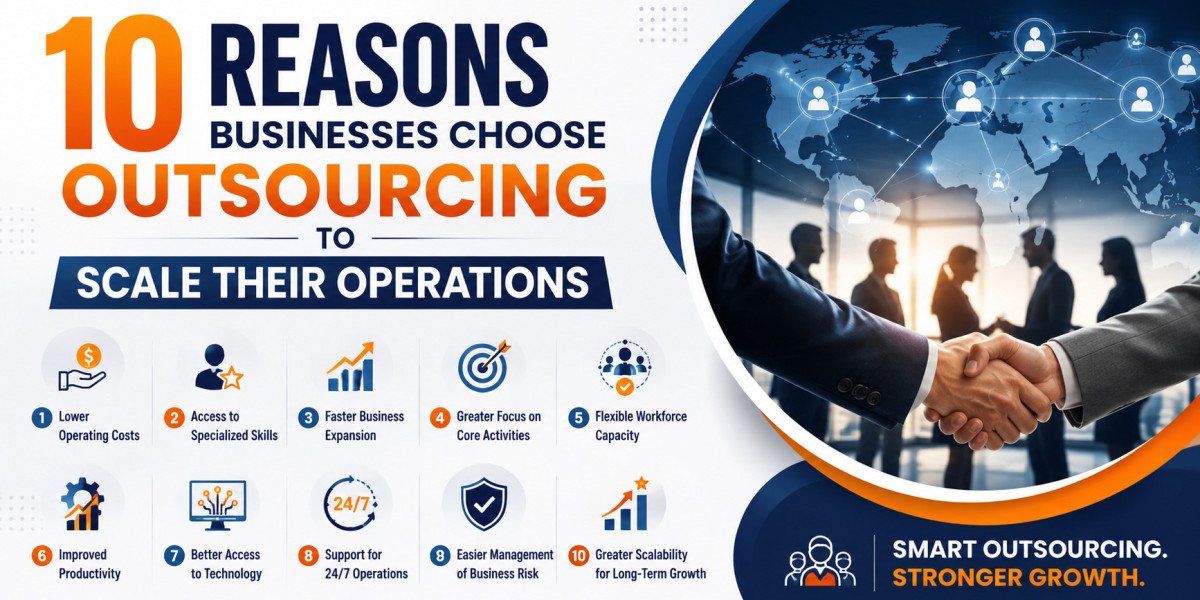

Growth is always a thrilling experience for a business, but growth can soon become complex and challenging. The greater the increase in customers’ demand, the more people, efficient processes, improved technology, and support businesses will need, without allowing cost increases to exceed income growth. Outsourcing Services have emerged as a solution for businesses seeking to grow effectively.
Businesses have the opportunity to outsource specific business functions to external experts without distracting their internal team from their core competencies. Business support services ranging from customer service, data handling, accounting, back office, and technical support are among the many other services that external companies can offer businesses.
1. Lower Operating Costs
Cost savings are one of the most important reasons why businesses consider outsourcing. Developing an in-house department entails costs such as salaries, benefits, recruiting costs, office space, hardware, software, and management of the new department.
Outsourcing firms have already incurred some of those costs due to their infrastructure and training of staff; hence, businesses only need to pay for the actual service they will use. It helps emerging companies that need more help than what they currently have, but do not want to incur big capital investment.
2. Access to Specialized Skills
Sometimes the scaling process involves skills that are not available within the organization. Recruiting specialists every time there is a need for something new takes quite a while, and it might not be cost-effective, considering that it is needed only for one particular function.
Business Outsourcing makes it possible for organizations to collaborate with specialists who already possess some experience in customer service, accounting, data processing, technical support, lead generation, and administrative management.
It is not necessary to spend several months finding new specialists and training them; it is enough just to collaborate with someone who has everything ready to go.
3. Faster Business Expansion
Growth opportunities may arise more rapidly than the ability to create internal capability within a firm. An abrupt rise in orders, customers, or requests for services could lead to strain on the current workforce.
An outsourced team will be able to handle extra operational workload. External workers can shoulder some of the process burden, thereby giving firms the ability to meet higher demands without waiting for their entire hiring process to be completed.
4. Greater Focus on Core Activities
For business owners as well as employees working in-house, it is ideal that their time be spent on tasks that are aimed at growth. However, the tasks which are done routinely may end up taking up much of the work time.
If the routine tasks are performed by someone outside, then the in-house staff can be freed to think strategically, develop products, sell, build relationships, etc.
The objective here is not merely to shift the tasks to some other organization. The idea is to improve the allocation of tasks between the two teams.
5. Flexible Workforce Capacity
The business demand is not always steady all year round. There may be seasonal peaks, promotional times, product launches, or an upsurge in consumer demand.
Keeping a large permanent staff for irregular demand may result in higher costs in leaner periods. It is more flexible to outsource, as businesses will have the ability to regulate the amount of external assistance based on their needs.
For instance, an e-commerce firm might need extra support from an outsourced firm during holiday promotions and require less manpower during lean periods.
6. Improved Productivity
Internal employees tend to lose precious time in managing such routine tasks along with their regular responsibilities.
Routine functions outsourcing can assist in defining better role clarity. The external professional will be able to concentrate on their designated operational work, and the internal employees will be able to give their best to their specific functions.
Standardized processes for task management, quality control, reporting, and performance management can also be followed by experienced service providers in managing the outsourced functions.
7. Better Access to Technology
Technology can help in improving the efficiency of businesses, but setting up the systems in-house would involve a lot of expenses and technical skills.
Outsourcing companies are usually equipped with specific software, communication channels, automation systems, CRM, data processing technology, and reporting systems.
It makes sense not to buy all these products individually but to use the technological framework that the outsourcing company is using. In this way, it becomes easier to update some processes without putting all the technological load on the shoulders of the in-house employees.
8. Support for 24/7 Operations
In today’s world, customers have high expectations for quick response, irrespective of the time zones or business hours of operation. It may prove difficult for organizations offering their services in various countries to ensure availability round-the-clock.
Outsourcing may offer greater feasibility of having an extended operational support system. Outsourcing to external people operating in shifts or from other parts of the world could be beneficial for handling customer queries, technical queries, and other procedures outside normal office hours.
9. Easier Management of Business Risk
There are risks involved with expansion. Rapid recruitment, large expenditure on infrastructure, or even setting up departments without sufficient demand may lead to increased financial burden.
Outsourcing offers an option for expanding some activities without having all the investments committed. Companies may experiment, expand support services, or enter into new market regions but with better control over operating expenses.
It should be understood that outsourcing will not remove all risks for businesses. They have to select appropriate vendors, set clear service standards, safeguard their critical data, and measure performance. The outsourcing contract should contain elements of defined duties, performance metrics, security measures, and communications.
10. Greater Scalability for Long-Term Growth
Scalability is likely one of the most significant benefits that outsourcing has to offer. The business should have a system that scales up along with the increase in sales and number of customers.
Such services as BPO Solutions allow this to be achieved through having outside teams perform specific tasks depending on the needs of the company. In this way, the company does not have to constantly restructure its own internal departments and adjust to changes in the needs of the business.
Making Outsourcing Work for Your Business
Outsourcing is not necessarily the right choice in every case. First, the firm must determine which processes are repetitive, costly, highly specialized, or challenging to control in-house.
Second, the organization should assess possible providers by their experience, services offered, communication approach, data protection, scalability, pricing, and reporting. At the same time, the scope of work should be clear to both parties. They need to agree on which functions will be delegated, which performance targets will be set, and how their success will be evaluated.
Finally, one should start with reasonable expectations. Outsourcing is effective if approached strategically and not only financially. An appropriate partner will complement the firm's activities with additional capacity, knowledge, and regularity.
Scaling Without Overcomplicating Operations
Expansion in business should open up opportunities for the business and not put undue pressure on the current workforce. As the business demand increases and the internal capabilities stretch, outsourcing may provide the extra capacity required.
From cost savings and access to specialized skills to increased flexibility and future expansion needs, there are several ways outsourcing could assist businesses in creating a more flexible business model.
For those companies that wish to grow their business without constantly investing in their own internal capabilities, the appropriate outside assistance could be an essential element of their growth strategy.