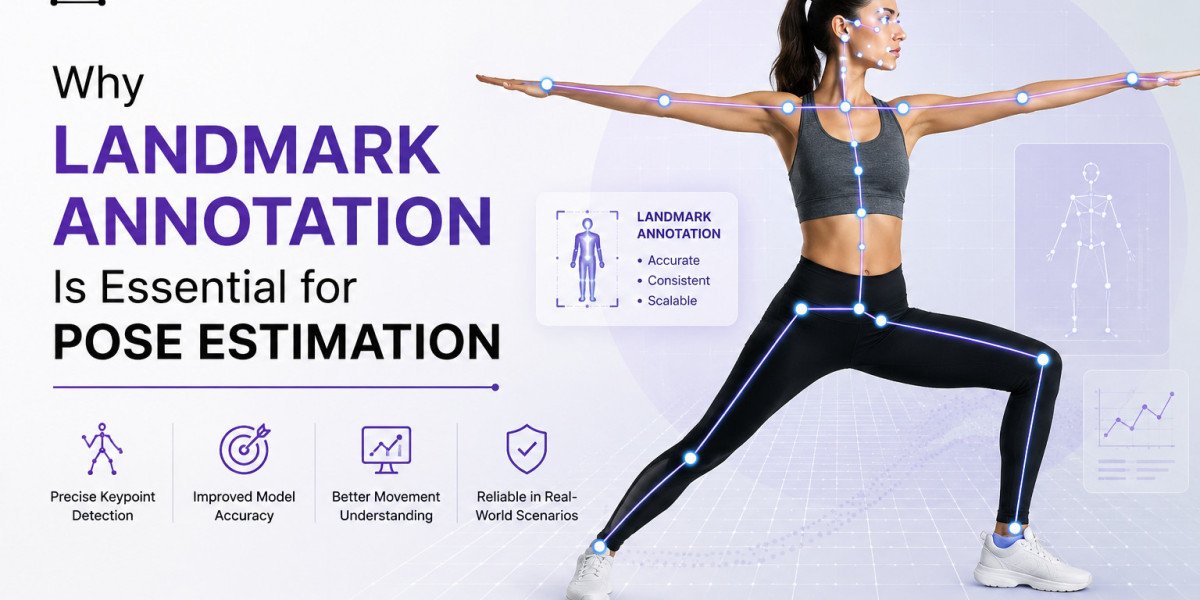

Pose estimation has become one of the most transformative technologies in artificial intelligence (AI), enabling machines to understand and interpret human movement with remarkable precision. From fitness tracking applications and autonomous vehicles to healthcare diagnostics and sports analytics, pose estimation models rely on accurately labeled datasets to identify key points on the human body. At the heart of these datasets lies landmark annotation, a specialized annotation technique that enables AI systems to recognize body joints, facial landmarks, and skeletal structures with high accuracy.
Without precise landmark labeling, even the most advanced AI models struggle to deliver reliable pose estimation results. This is why organizations increasingly partner with a trusted data annotation company offering image annotation outsourcing services to build scalable, high-quality datasets for computer vision applications.
In this blog, we'll explore why landmark annotation is indispensable for pose estimation, its applications, challenges, best practices, and how Annotera helps businesses build production-ready AI datasets.
What Is Landmark Annotation?
Landmark annotation is the process of marking predefined key points on an object or person within an image or video. These key points represent anatomical or structural locations such as:
- Eyes
- Nose
- Mouth corners
- Shoulders
- Elbows
- Wrists
- Hips
- Knees
- Ankles
- Fingers
Unlike bounding boxes, which only identify an object's location, landmark annotation provides detailed positional information that enables AI models to understand posture, orientation, and movement.
For human pose estimation, each landmark serves as a reference point for constructing a skeletal representation, allowing AI to interpret complex body movements accurately.
Understanding Pose Estimation
Pose estimation is a computer vision technique that detects and tracks the position of key body parts in images or videos. AI models learn the spatial relationships between annotated landmarks to estimate body posture in real time.
Pose estimation generally falls into two categories:
- 2D Pose Estimation – Detects body keypoints on a two-dimensional image.
- 3D Pose Estimation – Predicts body positions in three-dimensional space for more advanced motion analysis.
The accuracy of these models directly depends on the quality and consistency of landmark annotation.
Why Landmark Annotation Is Critical for Pose Estimation
1. Enables Accurate Keypoint Detection
Pose estimation models learn by recognizing relationships between annotated landmarks. Precisely placed keypoints allow AI to detect joints even under varying lighting conditions, viewing angles, and body orientations.
Poor annotations introduce noise into the dataset, reducing prediction accuracy and increasing false detections.
2. Improves Skeletal Reconstruction
Modern pose estimation algorithms generate virtual skeletons by connecting annotated body landmarks.
Accurate landmark labels help AI understand:
- Joint connections
- Limb orientation
- Body posture
- Motion dynamics
This skeletal understanding powers applications requiring precise movement analysis.
3. Handles Complex Human Movements
Real-world environments involve:
- Running
- Jumping
- Dancing
- Exercise routines
- Martial arts
- Team sports
Consistent landmark annotation enables AI to correctly interpret these dynamic poses, even when limbs overlap or become partially occluded.
4. Supports Multi-Person Pose Estimation
Many applications require identifying multiple people simultaneously.
Examples include:
- Sports broadcasts
- Crowd monitoring
- Retail analytics
- Workplace safety
- Public event surveillance
High-quality landmark annotation ensures AI accurately distinguishes body keypoints belonging to different individuals without confusion.
5. Enhances AI Model Generalization
Pose estimation models encounter diverse real-world conditions, including:
- Different body shapes
- Clothing styles
- Camera angles
- Ethnic diversity
- Lighting variations
- Motion blur
Comprehensive landmark annotation across diverse datasets helps models generalize better and perform consistently in unseen environments.
Industries Using Landmark Annotation for Pose Estimation
Healthcare
Medical AI uses pose estimation for:
- Physical rehabilitation monitoring
- Gait analysis
- Fall detection
- Elderly care
- Neurological disorder assessment
Accurate landmark annotation allows clinicians to monitor patient movements objectively and remotely.
Sports Analytics
Professional sports increasingly rely on pose estimation to analyze athlete performance.
Applications include:
- Swing analysis
- Running mechanics
- Injury prevention
- Motion comparison
- Performance optimization
Well-annotated datasets provide the precision required for biomechanical analysis.
Fitness and Wellness
AI-powered fitness applications use pose estimation to:
- Count repetitions
- Evaluate exercise form
- Provide posture correction
- Offer virtual coaching
These systems depend entirely on accurate landmark annotation to deliver meaningful feedback.
Autonomous Vehicles
Self-driving cars must understand pedestrian movement before predicting future actions.
Pose estimation helps detect:
- Walking direction
- Hand gestures
- Crossing intentions
- Sudden movements
High-quality landmark annotation improves pedestrian behavior prediction, contributing to safer autonomous navigation.
Robotics
Collaborative robots use pose estimation for:
- Human-robot interaction
- Gesture recognition
- Object handover
- Workspace safety
Reliable landmark annotation enables robots to interpret human movements more naturally.
Challenges in Landmark Annotation
Although powerful, landmark annotation presents several challenges.
Occlusions
Body parts may be hidden by:
- Objects
- Other people
- Clothing
- Camera angles
Annotators must follow consistent guidelines when landmarks are partially visible.
Motion Blur
Fast-moving subjects often create blurred frames, making keypoint placement difficult.
Diverse Human Anatomy
People differ in height, body proportions, age, and flexibility. Annotation teams must maintain consistency across these variations.
Annotation Consistency
Large datasets often involve multiple annotators. Without standardized workflows and quality assurance, landmark placement may become inconsistent and reduce model performance.
This is why organizations frequently choose data annotation outsourcing to experienced specialists who follow strict annotation protocols and multi-level quality reviews.
Best Practices for High-Quality Landmark Annotation
To build reliable pose estimation datasets, organizations should follow several best practices:
- Establish detailed annotation guidelines for every landmark.
- Use trained annotators familiar with human anatomy.
- Perform multi-stage quality assurance.
- Maintain consistent keypoint ordering across datasets.
- Include diverse demographics, environments, and camera angles.
- Validate annotations through expert review.
- Continuously update datasets with edge cases and challenging scenarios.
Partnering with an experienced image annotation company helps ensure these practices are consistently implemented at scale.
Why Businesses Choose Image Annotation Outsourcing
Developing pose estimation datasets internally can be resource-intensive and time-consuming. Image annotation outsourcing enables organizations to access skilled annotation professionals, scalable workflows, and rigorous quality control without expanding internal teams.
An experienced annotation partner provides:
- Faster project turnaround
- Consistent landmark placement
- Dedicated quality assurance processes
- Scalable workforce for large datasets
- Cost-effective operations
- Support for custom annotation guidelines
These advantages accelerate AI development while maintaining high dataset quality.
Why Choose Annotera for Landmark Annotation?
At Annotera, we understand that pose estimation models are only as accurate as the datasets used to train them. As a trusted data annotation company, we provide high-quality landmark annotation services designed for demanding computer vision applications.
Our expert annotation teams follow detailed labeling protocols and robust quality assurance processes to deliver precise, consistent annotations across diverse datasets. Whether you need annotations for healthcare, sports analytics, robotics, autonomous driving, or fitness applications, our scalable image annotation outsourcing solutions help accelerate AI development while ensuring exceptional data quality.
By combining human expertise with efficient annotation workflows, Annotera empowers organizations to build pose estimation models that perform reliably in real-world environments.
Conclusion
Pose estimation has become a foundational technology across numerous AI applications, but its success depends heavily on accurate landmark annotation. Precisely labeled keypoints allow AI models to understand posture, movement, and human behavior with greater accuracy, improving performance in healthcare, robotics, sports, fitness, autonomous vehicles, and beyond.
Organizations seeking reliable training data increasingly rely on data annotation outsourcing and image annotation outsourcing to achieve scalable, high-quality results while reducing development time. Partnering with an experienced image annotation company like Annotera ensures that every landmark is annotated with the precision needed to train robust, production-ready pose estimation models.
As AI continues to evolve, investing in high-quality landmark annotation will remain essential for building intelligent computer vision systems capable of understanding human motion with confidence.