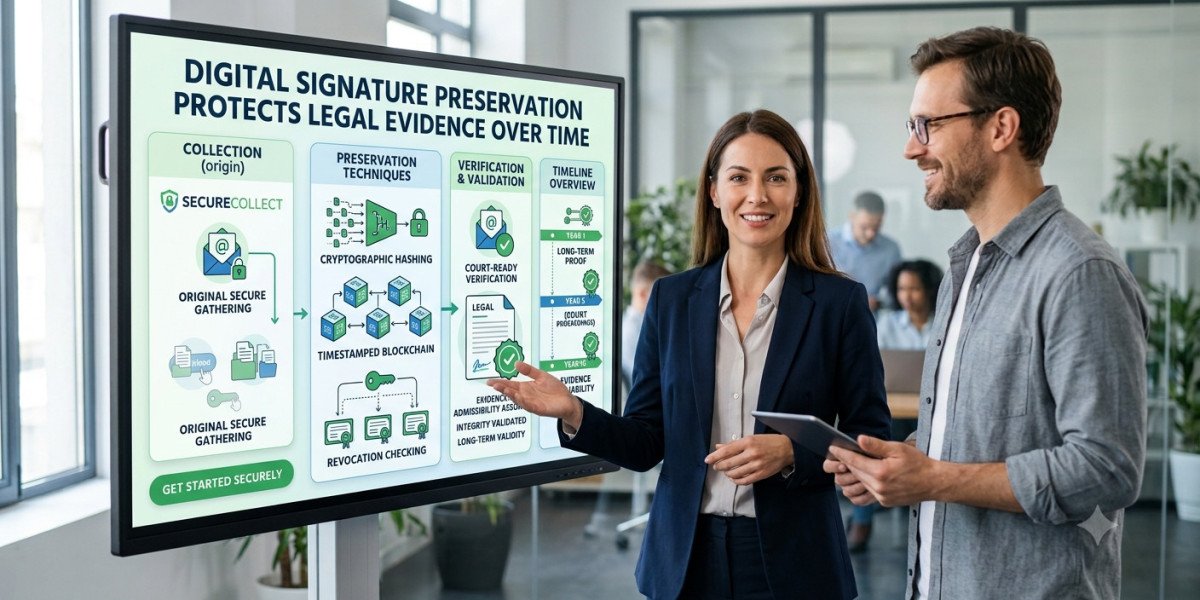

Picture a courtroom in 2035. Your company presents a supplier agreement signed digitally back in 2026, and opposing counsel asks one simple question: "Can you prove this signature was valid when it was made?" If the honest answer is no, a legitimate contract just lost most of its evidential weight. This is the problem digital signature preservation exists to solve. It is the practice of maintaining not just signed documents, but the complete body of proof behind their signatures, so they remain verifiable and defensible as legal evidence years or decades later. Signed records are only as strong as the evidence supporting them, and that evidence, unlike the paper world's ink and notary stamps, quietly disintegrates unless someone actively maintains it.
What Courts Actually Ask of a Signed Document
A digital signature makes three legal claims: the signer is who they say they are, the document has not changed since signing, and the signer cannot plausibly deny having signed it (non-repudiation). Each claim depends on evidence that must still exist and still be checkable when a dispute arrives:
Identity proof comes from the signer's certificate and the chain of trust connecting it to a recognised authority.
Integrity proof comes from cryptography that shows the document is bit-for-bit unchanged.
Timing proof comes from trusted timestamps establishing when the signature was applied, which matters enormously when certificates later expire or get revoked.
Status proof comes from revocation records (CRL or OCSP responses) showing the certificate was in good standing at the moment of signing.
Here is the uncomfortable part: most of this evidence lives outside the document, on servers run by certificate authorities and validation services. Certificates expire as a matter of routine. Revocation services get decommissioned and their records archived. Issuing authorities merge or disappear. Cryptographic algorithms like SHA-1, once trusted, become deprecated. None of this means your document was forged. It means that, without preservation, you may no longer be able to demonstrate it was not.
From Fragile Proof to Durable Evidence
Digital signature preservation works by capturing the proof while it still exists and then keeping that proof trustworthy over time. It happens in two layers.
Layer one: lock in the evidence at signing. Long-Term Validation (LTV), standardised through the PAdES profiles for PDF signatures, embeds the full certificate chain, the revocation status, and a qualified timestamp directly into the signed document. The document becomes a self-contained evidence package: a verifier in 2040 does not need to contact any long-gone server, because the proof travels with the file. Capturing this at signing time is critical, since revocation data that is not collected promptly may be impossible to retrieve later (Entrust).
Layer two: renew the evidence before it weakens. LTV is a snapshot, and snapshots age. Over 10, 20, or 30 year retention periods, the cryptography protecting the embedded evidence itself becomes vulnerable. Preservation services counter this with archival timestamps and evidence records: before an algorithm or timestamp weakens, a fresh, stronger qualified timestamp is applied over the whole evidence package, extending the chain of proof. Repeat this on schedule, and a signature can remain verifiable indefinitely, with an unbroken, documented lineage from signing day to courtroom day.
The Regulatory Backing That Makes It Count
Evidence is only useful if courts and regulators accept it, which is why the legal framework matters as much as the technology. In the EU, the eIDAS regulation, updated as eIDAS 2.0 and in force since May 2024, treats the preservation of qualified electronic signatures and seals as a regulated trust service, delivered by audited, supervised providers. Documents held in qualified electronic archives benefit from a legal presumption of integrity and origin recognised across all 27 member states. That presumption reverses the courtroom dynamic described at the start: instead of you proving the signature is still valid, the challenging party must prove it is not. Sector rules amplify the stakes, since financial records under MiFID II, employment documents, insurance policies, and clinical files routinely carry retention obligations of a decade or more, well beyond the lifespan of any signing certificate.
Conclusion
Legal evidence is not a property a signed document has; it is a property someone maintains. Digital signature preservation protects that evidence through two disciplined moves: embedding the complete proof package at signing time through LTV, and renewing it with archival timestamps before age and algorithm decay can erode it, ideally under a qualified trust framework that courts are bound to respect. If your ornganisation's contracts, HR records, or regulated filings may ever need to stand up in a dispute, treat their signatures as evidence under active care, not files in storage. The verdict you get in 2035 is being decided by the choices you make today.