
Artificial intelligence has transformed the way businesses automate visual tasks, from autonomous driving and retail analytics to medical imaging and industrial inspection. However, every successful computer vision model depends on one essential ingredient—accurately annotated training data.
Image annotation is the process of labeling visual data so AI models can identify, classify, detect, and understand objects within images. Choosing the right annotation technique is just as important as collecting quality data because different AI applications require different levels of precision.
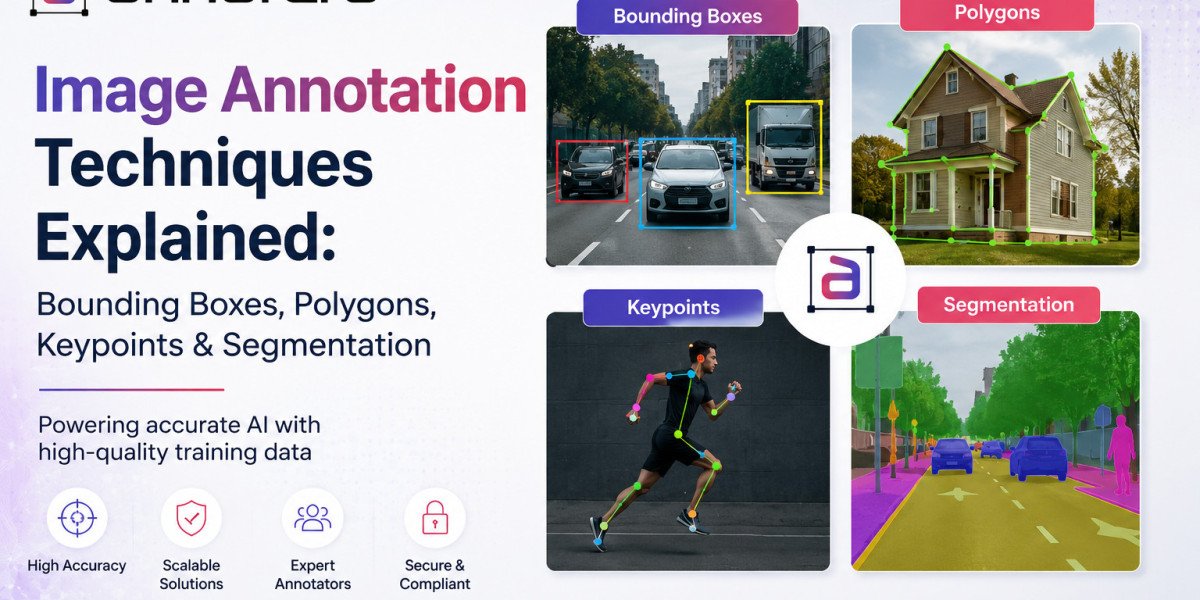
In this guide, we'll explain the four most widely used image annotation techniques—bounding boxes, polygons, keypoints, and segmentation—and discuss when each should be used. We'll also explore how partnering with a trusted data annotation company through data annotation outsourcing can improve annotation quality, scalability, and project efficiency.
Why Image Annotation Technique Matters
Every computer vision project has unique objectives. An autonomous vehicle must identify pedestrians, traffic signs, and surrounding vehicles in real time, while a healthcare AI model may need pixel-level precision to detect tumors.
Using an unsuitable annotation method can result in:
Reduced model accuracy
Increased false positives and false negatives
Longer training cycles
Higher annotation costs
Poor real-world performance
Selecting the appropriate annotation technique ensures your AI receives precisely the information it needs to learn effectively.
1. Bounding Box Annotation
Bounding boxes are the most commonly used image annotation technique. Annotators draw rectangular boxes around objects of interest, allowing AI models to learn object detection.
Best suited for:
Autonomous vehicles
Traffic monitoring
Inventory management
Retail shelf analytics
Security surveillance
Advantages
Fast annotation process
Cost-effective
Easy to scale
Ideal for detecting multiple object classes
Limitations
Bounding boxes only approximate an object's shape. When objects overlap or have irregular boundaries, the annotation may include unnecessary background pixels, reducing training precision.
For many object detection projects, however, bounding boxes provide an excellent balance between speed and accuracy.
2. Polygon Annotation
Polygon annotation allows annotators to trace an object's exact outline using multiple connected points.
Instead of drawing a rectangle, annotators carefully follow the object's edges to create a highly accurate representation.
Best suited for:
Buildings
Roads
Crops
Machinery
Medical structures
Construction sites
Advantages
Higher precision than bounding boxes
Excellent for irregularly shaped objects
Minimizes background noise
Improves segmentation quality
Limitations
Polygon annotation requires significantly more time and skilled annotators.
Although more expensive than bounding boxes, it delivers better performance for applications requiring precise object boundaries.
3. Keypoint Annotation
Keypoint annotation identifies specific landmark points on an object rather than outlining the entire object.
For humans, these landmarks may include:
Eyes
Nose
Elbows
Knees
Ankles
Fingertips
For vehicles, keypoints may represent headlights, wheels, mirrors, or corners.
Best suited for:
Human pose estimation
Sports analytics
Gesture recognition
Facial recognition
Robotics
Motion tracking
Advantages
Enables pose estimation
Supports motion analysis
Useful for behavior recognition
Requires fewer labels than segmentation
Limitations
Since only selected landmarks are labeled, keypoint annotation cannot describe an object's complete shape.
Nevertheless, it is indispensable for AI systems that analyze movement and body posture.
4. Image Segmentation
Image segmentation is the most detailed annotation method available.
Instead of labeling an object with a box or outline, segmentation labels every individual pixel.
There are two primary types:
Semantic Segmentation
Every pixel belonging to the same object category receives the same label.
Example:
All roads
All pedestrians
All vehicles
Objects of the same class are not distinguished individually.
Instance Segmentation
Each object receives its own unique label.
For example:
Car 1
Car 2
Car 3
Even if multiple cars appear together, each is segmented separately.
Best suited for:
Autonomous driving
Medical imaging
Satellite imagery
Agriculture
Robotics
Manufacturing inspection
Advantages
Pixel-level precision
Exceptional model accuracy
Superior object understanding
Better scene interpretation
Limitations
Segmentation is highly labor-intensive and requires experienced annotators, robust quality assurance, and advanced annotation tools.
Comparing Image Annotation Techniques
| Technique | Precision | Annotation Speed | Common Applications |
|---|---|---|---|
| Bounding Boxes | Moderate | Fast | Object detection, retail, surveillance |
| Polygons | High | Medium | Buildings, infrastructure, medical imaging |
| Keypoints | Landmark-based | Fast | Pose estimation, facial recognition |
| Segmentation | Pixel-level | Slow | Autonomous driving, healthcare, robotics |
The right annotation strategy depends on your AI model's objectives, budget, and required level of detail.
Beyond 2D: When 3D Cuboid Annotation Becomes Essential
While traditional image annotation works well for many computer vision applications, industries such as autonomous driving, robotics, and warehouse automation increasingly rely on 3D cuboid annotation.
Unlike 2D annotations, 3D cuboid annotation captures an object's width, height, depth, orientation, and spatial position. This enables AI systems to estimate distance, understand object dimensions, and navigate complex environments more accurately.
Many advanced AI projects combine image annotation with 3D cuboid annotation to create richer training datasets for multi-sensor perception systems.
Why Businesses Choose Data Annotation Outsourcing
Building an in-house annotation team can be expensive, time-consuming, and difficult to scale. As datasets continue growing into millions of images, organizations increasingly prefer data annotation outsourcing to specialized providers.
Benefits include:
Access to trained annotation experts
Faster project turnaround
Scalable production capacity
Lower operational costs
Consistent quality assurance
Multi-level review workflows
Support for diverse annotation techniques
Similarly, image annotation outsourcing enables businesses to focus on AI model development while experienced annotation professionals handle data labeling with accuracy and consistency.
Choosing the Right Data Annotation Company
Not every annotation provider delivers the same level of quality. A dependable data annotation company should offer:
Expertise across multiple annotation techniques
Domain-specific annotation teams
Rigorous quality control processes
Flexible scaling for enterprise projects
Secure data handling practices
Support for both image annotation and 3D cuboid annotation
Customized workflows tailored to your AI use case
Selecting the right partner ensures your datasets remain accurate, consistent, and production-ready throughout the AI development lifecycle.
Final Thoughts
Image annotation forms the foundation of successful computer vision systems. Whether your project requires fast object detection with bounding boxes, precise object outlines using polygons, motion analysis through keypoints, or pixel-perfect segmentation, selecting the right annotation technique directly impacts AI performance.
As computer vision applications become more sophisticated, organizations increasingly combine multiple annotation methods—and even integrate 3D cuboid annotation—to create richer datasets for advanced AI models. Working with an experienced data annotation company through data annotation outsourcing and image annotation outsourcing helps businesses accelerate development, maintain annotation quality, and build AI systems capable of delivering reliable real-world results.
At Annotera, we provide scalable, high-quality image annotation and 3D annotation services tailored to enterprise AI initiatives across industries, helping organizations transform raw visual data into accurate, AI-ready datasets.